
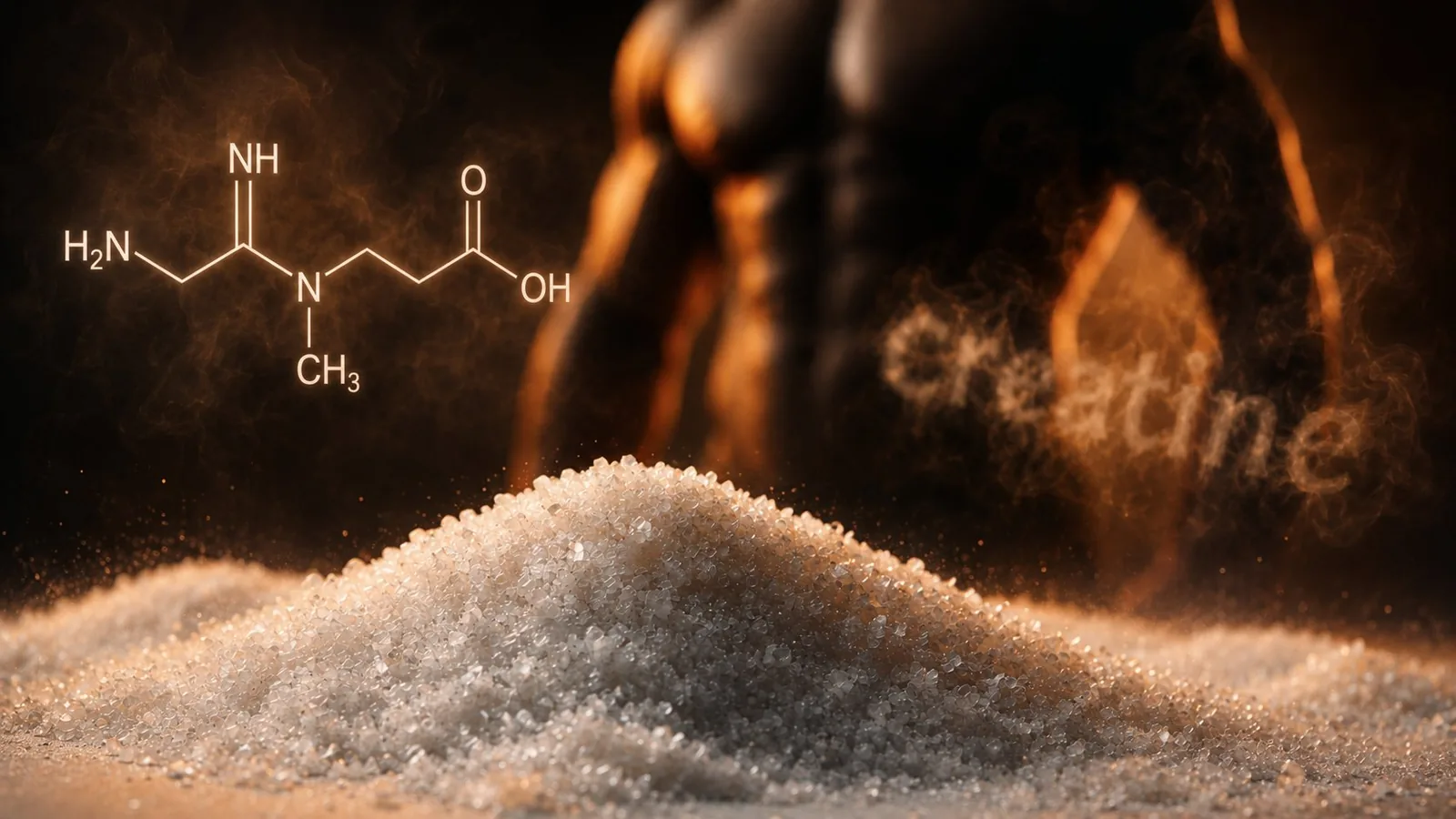
Creatine 2025: what's proven and what's hype
On 4 May, ScienceDaily published a review that once again put creatine in the spotlight – this time not as a supplement for muscles, but as a candidate for an over-the-counter therapeutic agent. Biohackers take it for memory, geriatricians recommend it for muscle mass, and vegans are offered it for neuroprotection. What of this is actually shown in studies, and what is well-aimed marketing?
I spent the day reading meta-analyses from the last two years. The one-sentence conclusion: at one end of the spectrum, there's really robust data for sarcopenia and strength training, and at the other, depression and “creatine for the mind,” where the hype is half a step ahead of the evidence. I'll go through them one by one.
Як креатин працює, коротко
Creatine is neither a vitamin nor a steroid (despite a persistent internet myth). It is an organic compound produced naturally by the body in the liver, kidneys and pancreas from three amino acids: glycine, arginine and methionine. Around 95% of the body’s stores are found in skeletal muscle, with the remainder in the brain, heart and other organs.
The function is simple: when a cell needs a quick energy hit – an explosive movement, an intense cognitive task, fight-or-flight – it burns ATP, the universal energy currency. ATP runs out in seconds. Creatine, in the form of phosphocreatine, donates its phosphate group and instantly regenerates ATP. This is its role – a buffer for the quickest energy demands.
On a typical meat-based diet (1–2 g of creatine from food per day), muscle stores are 60–80% full. Supplementation increases intramuscular creatine and phosphocreatine by 20–40%. This is the biological basis for all the effects. The rest is a question of where exactly this buffer comes into play.
Sporting performance is the strongest evidence
This is the oldest and strongest part of the data. A greater effect in work lasting several seconds at high intensity – sprints, heavy sets, explosive exercises, repetitions to failure. In endurance (marathon, multi-hour cycling race) there is almost no effect – the fuel there is different.
Dosage. Classic protocol: loading 20g/day (4 servings of 5g) for 5-7 days, then maintenance 3-5g/day. Alternative – just 3-5g/day from scratch. Muscle saturation occurs in ~28 days. The effect is the same, you just reach the plateau slower. Loading makes sense if the effect is needed urgently (before a competition); in normal life – it's an unnecessary strain on digestion, as gastrointestinal distress occurs more often with high single doses.
The word "Форми" in Russian translates to "Forms" in English (UK). Industry is constantly inventing “improved” creatines — ethyl ester, HCl, buffered (Kre-Alkalyn), nitrate, citrate. Marketing promises better absorption, less water retention, effect from lower doses. Reality: in head-to-head RCTs, none of these forms outperformed monohydrate. Creatine ethyl ester in Spillane et al. 2009 showed worse results – it degrades faster to creatinine, even before reaching the muscles. The ISSN in their 2017 position stand was unequivocal: no alternative form has shown better retention in muscles than monohydrate in peer-reviewed publications.
If you're paying three times more for HCl, you're overpaying for marketing. Monohydrate with third-party certification (Creapure, NSF Certified for Sport, Informed Choice) is enough.
Older age and sarcopenia are the strongest “out-of-gym” use-cases.”
A recent meta-analysis of 17 RCTs (n=456) showed that adding creatine to strength training in people aged 60+ gives ~1.2 kg more lean mass than the most powerful, plus better results in chest press and leg press. Creatine without training has a modest effect; together with strength training, it's synergistic.
This is important because muscle mass after 50 is not an aesthetic issue, but a predictor of functional independence, risk of falls, and lifespan. Muscles are the largest metabolically active organ. Muscle loss equals loss of metabolic flexibility (I wrote about this in the post on iron versus protein).
A separate case is postmenopause. Women have a 70–80% lower endogenous creatine baseline than men. A review by Smith-Ryan et al. (2021, updated in 2025 in JISSN) showed that postmenopausal women on a high-dose protocol (0.3 g/kg/day, i.e. ~20 g for a 70-kg person) experienced increased FFM, strength gains, and better results in sit-stand and tandem gait tests. Bone density is an additional benefit when combined with strength training.
Transparency Smith-Ryan and Candow, leading authors of female reviews, are scientific advisors for Alzchem, a creatine manufacturer. This does not disqualify the data (RCTs are RCTs), but it's better to know than not to know.
Cognition: where the evidence is strong and where the hype outpaces the data
Here's where it gets interesting—and this is precisely where you should be cautious about what you read on the internet.
What are popular articles writing about. “A meta-analysis from 2024 showed that creatine improves memory, attention, and processing speed. This refers to Xu et al. 2024 in Frontiers in Nutrition (16 RCTs, n=492). The authors did indeed find significant effects: memory SMD=0.31, processing speed SMD=-0.51.
What no one is writing. European Food Safety Authority (EFSA) in 2024 in scientific opinion failed the methodology of this meta-analysis. The reason is a unit-of-analysis error: the authors pooled multiple correlated cognitive outcomes from the same participants as independent effect sizes. Some included trials had up to 7 memory subtests for a single sample. This artificially inflated the sample size. EFSA's comment: “no conclusions could be drawn.” Frontiers published a commentary in February 2026 with the same conclusion and suggested re-analysis with multilevel models.
So the headline “Creatine improves cognition” is based on a meta-analysis that a leading regulator deemed unsuitable for drawing conclusions. This is No means that creatine is not effective for cognition - this means that we do not yet have a clear answer.
What remains to be proven. Sleep deprivation. Gordji-Nejad et al. 2024 (Scientific Reports) gave healthy participants a high single dose of 0.35 g/kg (~25 g for a 70 kg person) during 21 hours of sleep deprivation. 3-4 hours after administration – improved working memory and processing speed; peak effect at 4 hours, duration up to 9 hours. Changes were also seen in brain phosphocreatine on ³¹P-MRS. A follow-up in 2025 in Nutrients with a lower dose (0.2 g/kg) also showed effects on logical/numerical tasks and the Psychomotor Vigilance Test. This not “creatine for the mind daily” — this is a point intervention for specific stress (night shift, jet lag, sleepless deadline).
Vegan benefits - also mixed. The logic is simple: vegans don't eat meat → lower baseline → greater potential. In muscles, yes, the baseline is lower (~100 vs ~120 mmol/kg dry muscle). But Creatine brain in Solis 2017 was similar across groups despite different plasma levels, the brain seems to compensate with local synthesis. And Sandkühler 2023 - the largest cognitive RCT (n=123, roughly half vegetarians) - without showing significant interaction Between diet and cognitive outcomes. That is, the popular narrative “vegans will get greater benefit for the brain” is based on older and smaller studies; newer and larger ones do not support it.
Depression: why enthusiasm precedes data
Nutritional psychiatry has recently been actively discussing creatine as an adjunct to antidepressants. The theoretical basis is strong – the depressed brain has reduced ATP/phosphocreatine in the frontal cortex and hippocampus (visible on ³¹P-MRS). Creatine could theoretically “refuel” it.
A clinic is a separate matter. The most comprehensive meta-analysis of 2025 in the British Journal of Nutrition (11 trials, n=1093) summarised as follows:
- SMD = -0.34, 95% CI: -0.68 to -0.00 (i.e. the upper limit is close to zero)
- GRADE: very low quality of evidence
- Heterogeneity I² = 71.3% — that’s a lot
- 6 out of 11 trials had a high risk of bias; only 1 had a low risk
- Trim-and-fill and funnel plot showed substantial publication bias in favour of creatine
The authors“ own conclusion: ”true effect may be trivial or null".
This does not mean “it doesn’t work”. It means that for now, we don’t know, and the data is favouring it – likely exaggerated due to bias and selective reporting. If you see in a popular podcast creatine presented almost as a quasi-antidepressant – that’s getting ahead of the evidence base by one or two research iterations.
What remains solid: for people already on SSRIs/SNRIs with treatment-resistant depression, small pilot trials (Kious 2017) showed benefit. This is a signal worth pursuing - but not the basis for cabinet recommendations.
Security: The myth of kidneys and an important analytical nuance
The most persistent myth is “creatine harms the kidneys”. Here, one important nuance is needed, which even doctors sometimes confuse.
When the body uses creatine, the by-product is creatinine. This is a breakdown molecule that the kidneys excrete. The concentration of creatinine in the blood is a standard clinical marker of kidney function (from which eGFR is calculated).
What happens during supplementation: part of the ingested creatine is spontaneously converted to creatinine even before being used by the muscles. I.e. serum creatinine is rising — without any renal dysfunction. This is not damage, it is background noise.
The latest systematic review + meta-analysis in 2025 from Frontiers in Nutrition showed exactly this: serum creatinine increases slightly but statistically significantly, GFR remains unchanged (that is, the real function of the kidneys is intact).
A practical tip: if you're taking creatine and going for clinical tests, let your doctor know. Otherwise, you could get a false diagnosis of renal impairment and unnecessary anxiety. Alternatively, do a 7-day washout period before your test so that the marker returns to its baseline.
One remains cautious
- Pre-existing kidney disease — consult the nephrologist before starting
- Pregnancy / lactation — there's little data, better be careful
- 1990s case reports The panic was triggered by the fact that almost everyone had pre-existing renal pathology, rhabdomyolysis from intense labour, or simultaneously took other nephrotoxic substances.
For healthy individuals at doses up to 20g/day in RCTs lasting up to 5 years, nothing concerning has been found. Creatine is one of the most well-researched supplements overall.
What can be done from this
If you are an adult without kidney problems:
- 3-5 g monohydrate daily, constantly, not in cycles. Loading optional
- Don't pay for HCl, ethyl ester or “advanced” forms – overpaying without proof
- Look for Creapure or NSF Certified for Sport on the packaging
- Can be taken at any time, with anything. The carbohydrate slightly improves uptake via insulin, but it's marginal.
Who is this particularly relevant to:
- Law enforcement/athletes with explosive training – classic evidence
- The strongest “outside the gym” use-case for people over 50 who train with weights.
- Post-menopausal women – likely with higher doses (0.3 g/kg) to notice a difference
- Those who have a sleep deprivation phase ahead of them (night shift, deadline, jet lag) – a single, one-off dose, not daily
The evidence is not yet ripe
- As a daily cognitive enhancer for healthy individuals, meta-analyses are methodologically weak
- How support for depression - meta-analysis 2025 showed possible null effect
- Vegan/vegetarian advantage in cognition - latest large RCTs do not confirm
What should definitely not be done:
- To think this is a steroid (it's not a steroid)
- Pay three times more for “advanced” forms
- Waiting for magic is a buffer for the energy system, not a drug.
And one last thought. Creatine is a good illustration of how modern nutra-science works. Strong evidence in one niche (muscles, sarcopenia), expansion into adjacent territories (cognition, mood, neuroprotection), and there everything quickly becomes mixed: small trials with enthusiasm, meta-analyses with methodological problems, regulators that are flustered, enthusiasts who are ahead of the data.
In such a situation, the most useful thing is not to chase headlines, but to keep in mind where the evidence is strong (and to take it), where there's a hint (and to wait), and where it's speculation from a single pilot study (and not to pay three times for it).
Primary sources mentioned in the text:
- Kreider RB et al. (2017) — ISSN position stand. Journal of the International Society of Sports Nutrition. DOI: 10.1186/s12970-017-0173-z
- Xu C et al. (2024) — meta-analysis of creatine and cognition. Front Nutr. DOI: 10.3389/fnut.2024.1424972
- Frontiers commentary (2026) on Xu et al. with criticism of the methodology. DOI: 10.3389/fnut.2026.1716285
- Gordji-Nejad A et al. (2024) — single high dose and sleep deprivation. Scientific Reports. DOI: 10.1038/s41598-024-54249-9
- Follow-up with a lower dose (2025) — Nutrients 18(8):1192. DOI: 10.3390/nu18081192
- Sarcopenia meta-analysis of 17 RCTs (2021) Nutrients 13(6):1912. DOI: 10.3390/nu13061912
- Smith-Ryan AE et al. (2021) — women's health lifespan review. Nutrients 13(3):877
- Smith-Ryan AE et al. (2025) — updated women's review. Journal of the International Society of Sports Nutrition. DOI: 10.1080/15502783.2025.2502094
- Depression systematic review + meta-analysis (2025) British Journal of Nutrition. DOI: 10.1017/S0007114525105588
- Kidney safety — systematic review + meta-analysis (2025), Front Nutr 1682746
- Spillane M et al. (2009) — CEE vs monohydrate. Journal of the International Society of Sports Nutrition
- Sandkühler (2023) — the largest cognitive RCT comparing vegetarians vs. omnivores
- ScienceDaily / Boroujerdi M (2026) — handbook-based trigger review. DOI: 10.1201/9781003604662





 Українська
  English (UK)