
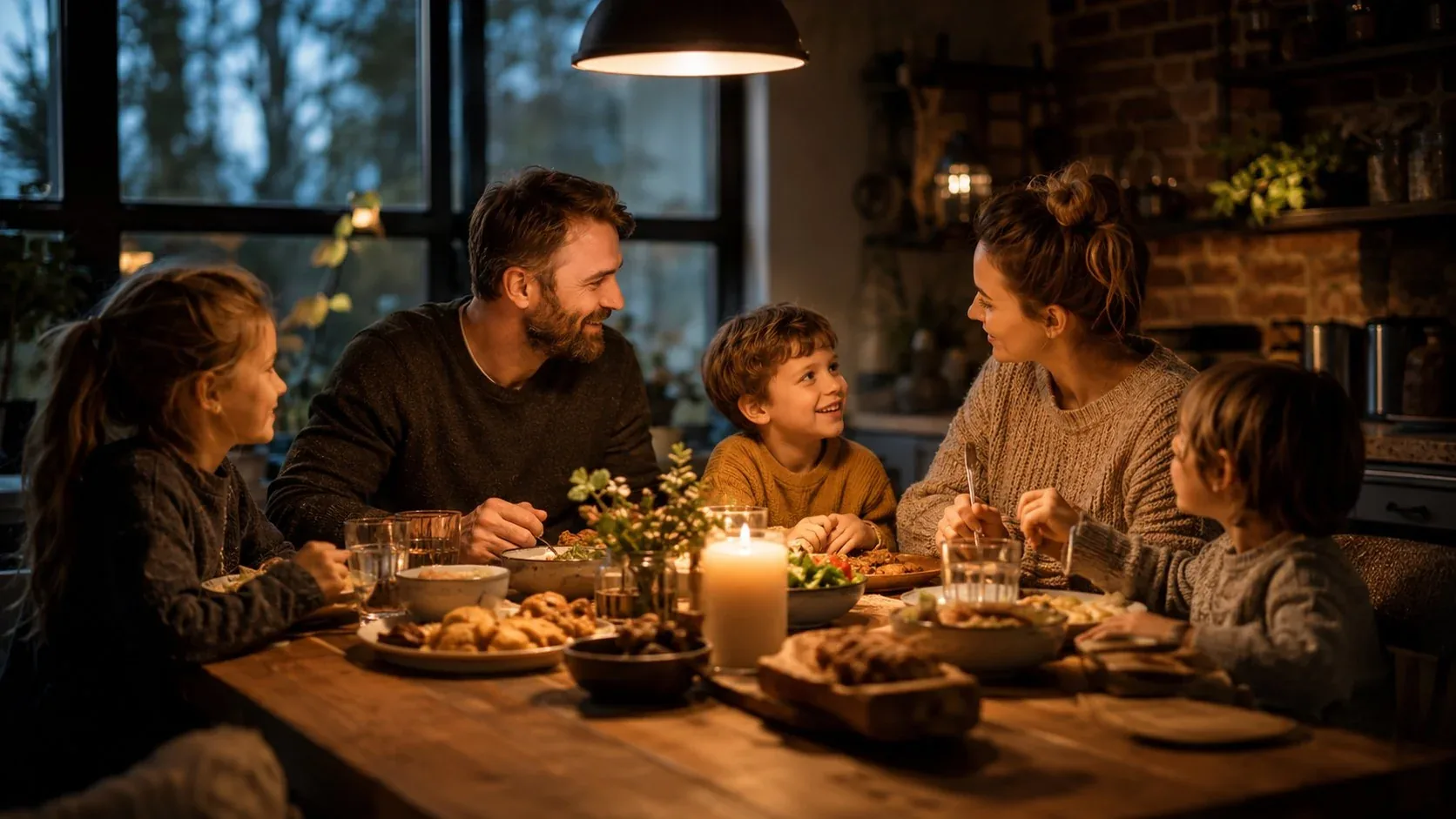
Family dinner: 1,000 rare words and four times lower risk – what a shared meal really does.
Family dinner isn't about food. The most accurate figure in the whole topic belongs not to nutrition, but to linguistics. A small child hears around 1,000 rare words at the dinner table. Reading a book aloud yields only 143. It sounds like an argument against books – but it's not. It is the confusion surrounding figures like these that has turned a useful idea into a pile of half-truths. This article is a full breakdown of what research shows about shared dinners, and what has been added from speculation.
Why has the family dinner become a topic for science?
The shared meal seems too mundane an activity to warrant study. That, as Robin Dunbar of Oxford observes, is precisely why the phenomenon remained overlooked by evolutionary psychology for so long. This is despite the fact that communal eating is a human universal, from feasts to everyday family dinners.
The interest arose when the scale of the opposite – solitary eating – became apparent. According to the British National Diet and Nutrition Survey, on which Dunbar relied, a third of weekday dinners are eaten alone. The average adult eats ten out of twenty-one weekly meals by themselves. This means the question of a family dinner is not rhetorical. A significant number of people are already living in a way that is the opposite of what has been the norm for millennia.
When something so ancient begins to disappear, it's worth first understanding exactly what we are losing. And here, science provides two lines of evidence of differing strength. One is solid, with concrete figures. The second is more of a plausible hypothesis, often presented as an established fact. Separating them is the main task of this analysis.
A 790,000-year-old hearth: why family dinner is older than our species
The habit of gathering around food is older than Homo sapiens. Traces of controlled fire use, dating back around 790,000 years, have been found at the Gesher Benot Ya'aqov site in the Jordan Valley. This is one of the oldest known hearths. Alongside remnants of burnt wood and seeds, edible plants were discovered there: olives, wild barley, and wild grapes.
Later analysis of the same site went further. From the teeth of over forty thousand fish, researchers showed that the fish were not just eaten there, but cooked. It was heated to 200-500°C, i.e. in the conditions of a campfire, around 780,000 years ago. This is the earliest known evidence of intentional food preparation. A detail that speaks volumes: there were almost no fish bones left, but the teeth were preserved. Bones soften and disintegrate when heated below 500°C, but teeth do not. This means it was not accidentally burnt prey, but systematic thermal processing.
The campsite as a whole has a surprisingly homely feel. Around the patches of burnt material, archaeologists found the remains of a wide range of food – nuts, fruits, seeds, fish, crabs, even small animals. Nearby, they made stone tools and cracked nuts on anvil stones. Other work was carried out separately. This is no longer just a fire for warmth, but an organised space where food was gathered, prepared, and eaten together.
Why this is important to the topic. Anthropologists have long suggested that it was the hearth around which social life formed. Here people would warm themselves, share food, exchange information, and hide from predators. The expansion of social networks around shared meals is one of the pathways that led to the complex social life of modern humans.
The conclusion is simple. Family dinner is not an invention of the 20th century with its cult of family values. It is a behavioural pattern almost a million years old, embedded in us deeper than any fashion for «quality time».
What did the linguistic development study show
The hardest fact in the topic concerns children. Catherine Snow, a professor at the Harvard Graduate School of Education, along with her colleagues, has studied for decades how mealtime conversation impacts speech. In Snow and Bill's 2006 work, mealtime dialogues are described as an environment where a child acquires vocabulary. There, they learn to construct and understand narratives, gain general knowledge, and master culturally acceptable ways of speaking.
The key concept is «rare words». These are words outside the list of the three thousand most common. It is their proportion that subsequently determines vocabulary and literacy. Everyday communication revolves around a narrow core of the most frequent words, and more complex vocabulary comes from context. Table talk turned out to be a surprisingly generous source of such words. There they sound natural, in a living situation, rather than like a learning exercise.
The mechanism for this is simple and requires no magic. Over dinner, conversations naturally move beyond «pass the salt.» Adults share what happened during their day, explain things, reminisce, and debate. Within this flow, words that aren't part of a child's everyday vocabulary naturally emerge—names of phenomena, professions, emotions, abstract concepts. The child hears them in a comprehensible context and gradually adopts them. This isn't a lesson; it's a by-product of adults simply speaking in a more complex way in their presence.
This is where the figure of a thousand rare words at the dinner table versus one and a half hundred from reading aloud comes from. It needs to be understood correctly. The table here is a supplement to reading, not a replacement for it. A child who listens to books and talks at dinner receives two different streams of complex language. The strong thesis of the study is not that conversation is better than books. It is that the shared table is a separate, underestimated, and free source of language development.
Honest counter-argument: conversation or reading
Science is not united on this, and an honest analysis must say so. Dominique Massaro of the University of California, Santa Cruz, reached the opposite conclusion in 2015. The written language of books contains words outside the five thousand most common three times more often than the spoken language of an adult to a child. According to this logic, reading aloud builds vocabulary more effectively than conversation.
This doesn't undermine the thesis about family dinners. Both channels are beneficial, and no one is seriously suggesting choosing only one. However, the phrasing «studies have shown that the dinner table is more important than books» is more definitive than it actually is. It's more accurate to say otherwise. Dinner conversation is a powerful source of complex vocabulary, which works alongside reading, not instead of it.
This caution is not pedantry. An audience that reads primary sources will immediately recognise exaggeration. And one exaggeration devalues ten honest figures. Therefore, a simple rule will apply from now on: where the evidence is weaker, it will be stated as such.
Teens, alcohol and drugs: Colombia's figures
A second solid line of evidence concerns teenagers. The National Centre on Addiction and Substance Abuse at Columbia University (CASA) has produced its «Importance of Family Dinners» report series for years. These were not one-off surveys but an annual series that tracked the same pattern for decades. The 2011 report compared two groups of teenagers. The first group ate dinner with their families frequently—5 to 7 times per week. The second group ate dinner with their families infrequently—fewer than three times.
The gap turned out to be significant. Teenagers with infrequent family dinners were almost four times more likely to smoke. They were more than twice as likely to use alcohol and 2.5 times more likely to use marijuana. There was another indicator that was most concerning. Teenagers with infrequent dinners were more likely to say that they saw themselves as likely to try drugs in the future. This means it's not just about current behaviour, but also about the willingness to take risks itself.
The figures are impressive, and that's precisely why they're the easiest to get wrong. It's correlation, not causation. The founder of CASA himself stated this directly: the magic of the family dinner isn't in the food on the table, but in the conversation and family engagement. The frequency of dinners here is more of a marker of general parental presence than an independent cause. The same report also showed a related point. Frequent dinners are linked to better relationships with parents. A teenager from such a family is more likely to have someone to turn to at home.
The same report showed another slice. Teenagers who spend 21 hours a week or more with their parents are at less risk than those who spend seven hours or less. Shared dinners are simply the most visible slice of this presence. Therefore, treating it as a magic bullet is a mistake. It is an indicator, not a lever.
Why family dinner works for adults: endorphins, not a fabricated neuromechanism
If family dinner truly offers adults something, what is it specifically? This is where one must tread carefully with words.
In his 2017 paper, Dunbar, using data from a British survey, showed something important. Those who eat in company more often have several advantages simultaneously. They feel happier and more satisfied with life. They trust others more. They have a wider circle of people to rely on. Particularly valuable is how this result was obtained. Path analysis in the study indicated the direction of causality – from eating together to a sense of connection, and not the other way around. This is a rare case where correlation data allows for a careful inference of cause, not just coincidence.
An interesting detail about dinners that work best. According to Dunbar, feasts with more people, laughter, and memories bring people closest together. This means it's not about calories or the menu, but about what happens between people at the table.
Regarding the Dunbar mechanism, he discusses the endorphin system. The act of eating, shared laughter, and synchronous behaviour at the table can trigger the release of endorphins. These are the same substances involved in social bonding in primates and humans. The model is plausible and supported by related data.
And as for oxytocin, which is presented in popular texts as the main «bonding molecule» – that's still a hypothesis. Most direct evidence about oxytocin has been obtained in other contexts: touch, breastfeeding, animal experiments. Its role specifically at the family table has not been proven. Therefore, the honest formulation sounds like this: endorphins are likely involved, possibly oxytocin. Not «a shared meal releases oxytocin».
The weakest point of the topic: «mirror neurons» and broccoli
There's a claim that's circulating from text to text. Children supposedly pick up eating habits through mirror neurons, so by seeing their parents eat broccoli, they start eating it themselves. It sounds scientific. In reality, this is the weakest link in the entire topic.
The fact that children copy adult eating behaviours is well-documented. It's classic observational learning, modelling. However, attributing the effect specifically to «mirror neurons» is a scientific liberty. The very existence and function of mirror neurons in humans are still debated. No study has established a direct link: «mirror neuron fired – child ate broccoli». It's a beautiful metaphor presented as a mechanism.
The conclusion remains correct. Children do indeed eat better when they see their parents eating well. This just needs to be explained through behavioural modelling, rather than by naming neurons added for gravitas. Shared mealtimes work as an example to follow. And that is quite sufficient to avoid inventing non-existent neurobiology.
What makes a dinner a dinner, rather than just a meal in a room
A common denominator emerges from all the research, and it’s not about food. In the CASA report, the most harmful combination was found to be infrequent dinners with distractions at the table – phones, laptops, televisions. This combination sharply increased risks compared to dinners without screens. In Dunbar’s study, the strongest link was found with dinners involving more people, laughter, and reminiscing. In Snow’s research, the value was created by conversation, rather than simply sitting at the table.
So it's not the table or the food that has an effect, but the interaction. A dinner where everyone stares silently at their own screen is, in effect, closer to eating alone than eating together. For many, this is good news. Even a short meal works, if it's a real conversation and not just being in the same room concurrently.
This is where the practical guideline comes in. The value of family dinner lies in the ritual of engagement. It's regularity, attention to one another, absence of screens, and a live conversation. Everything else – the menu, the setting, the duration – is secondary.
What to do with this: family dinner without myths
Several conclusions that flow from the evidence, rather than from wishes.
For families with children, table talk is a separate source of complex vocabulary that works alongside reading. Not «instead of books» and not «most importantly,» but an independent channel. It's easy to switch it on: just talk to your child at the table about various things, without artificially simplifying the language.
For families with teenagers, regular dinners are more of an indicator than a lever. On its own, it doesn't «protect» against risks. Parental presence and involvement, of which dinner is the most visible manifestation, are what protect. Therefore, the goal should not be «five dinners a week» for the sake of ticking a box, but rather genuine conversation and attention.
For anyone, a family dinner is an inexpensive investment in their own sense of connection and life satisfaction. It's one of the few cases where correlational data has been carefully twisted towards causation. The main condition is singular: put away the screens and talk. [insert personal detail here – what this looks like in your family]
What's next: where is this topic leading
Dinner with family is the root from which several narrow storylines diverge. Each is worth analysing separately. The first is the effect of screens at the table on sleep and digestion. The second is the link between eating alone and poorer food choices. The third is the modelling of eating behaviours in children without any neuromythology. The fourth is what is known about the link between loneliness and physical health. Each of these is a separate article that will be linked here as a common anchor.
The same habit of separating strong evidence and good metaphors underlies our other analysis — Andrew Huberman's full protocol by levels of evidence, where the daily routine, sleep and rituals are broken down into «what works unequivocally» and «what's more of a habit». Family dinner is part of the same lifestyle approach. The rest of the materials in this vein we collect in Article Categories.
If you boil it down to a single sentence, it's this. The value of a shared dinner isn't in the food or the neurotransmitters, but in the fact that it's almost the only regular occasion to be together and talk. And it's precisely this that people are increasingly lacking.
Sources
- Snow CE, Beals DE. Mealtime talk that supports literacy development. New Directions for Child and Adolescent Development. 2006;2006(111):51-66. DOI: 10.1002/cd.155
- Dunbar RIM. Breaking Bread: the Functions of Social Eating. Adaptive Human Behavior and Physiology. 2017;3(3):198-211. DOI: 10.1007/s40750-017-0061-4
- Goren-Inbar N, Alperson N, Kislev ME, et al. Evidence of Hominin Control of Fire at Gesher Benot Ya’aqov, Israel. Science. 2004;304(5671):725-727. DOI: 10.1126/science.1095443
- Zohar I, Alperson-Afil N, Goren-Inbar N, et al. Evidence for the cooking of fish 780,000 years ago at Gesher Benot Ya’aqov, Israel. Nature Ecology & Evolution. 2022;6(12):2016-2028. DOI: 10.1038/s41559-022-01910-z
- The National Centre on Addiction and Substance Abuse at Columbia University (CASA). The Importance of Family Dinners VII. 2011.
- Massaro DW. Two Different Communication Genres and Implications for Vocabulary Development and Learning to Read. Journal of Literacy Research. 2015;47(4):505-527. DOI: 10.1177/1086296X15627528






 Українська
  English (UK)