
Nutrition education for athletes: +23% in knowledge or +7% from the test itself?
Nutrition education It sounds like a sure-fire strategy: teach an athlete how to eat properly — and get better results. A new study involving 198 military athletes in Lebanon appears to confirm this: the training group’s knowledge scores rose by 23%. But there’s a figure lurking in the background that the headlines fail to mention. The control group, which received no training whatsoever, also improved their knowledge — by 7.2%. Let’s break down what constitutes a genuine effect here and what is merely a measurement artefact.
What did the research show about nutrition education
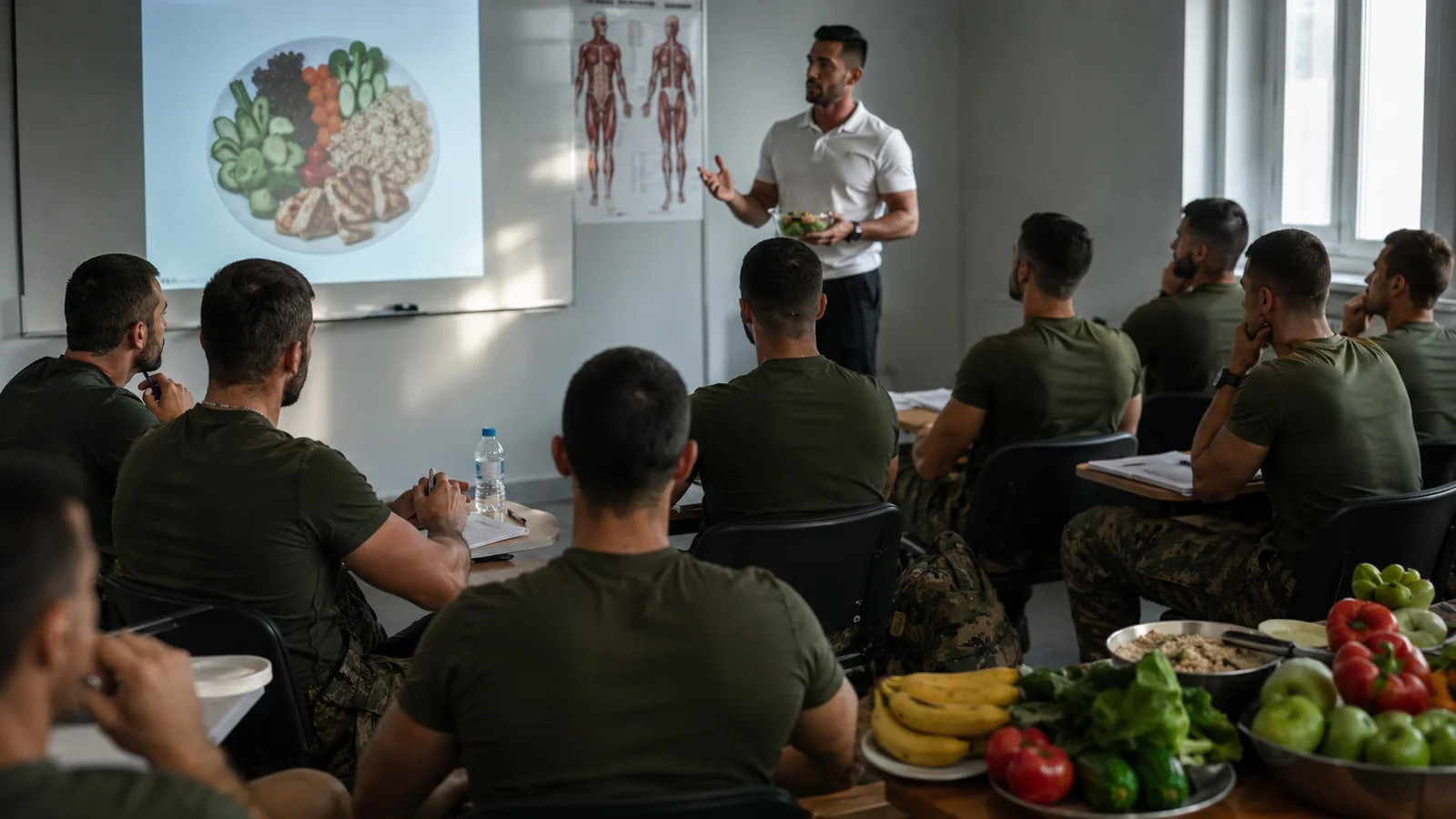
The work came out on Journal of the International Society of Sports Nutrition In 2026. 198 athletes from army and internal troops sports teams were divided into two groups. 151 received a 4-month programme Nutrition education, and 47 completed the control without interference.
The programme was intensive. Three 60-minute lectures, monthly educational posters, group sessions, individual consultations with a dietician. All of this led to one goal – not just to impart facts, but to change behaviour at the plate.
Measurements were taken twice, before and after. Validated questionnaires on knowledge and eating habits, along with four 24-hour dietary recalls, were used. A beep test was added to assess VO2max, and one-repetition maximum tests were conducted for five exercises. This means we recorded not only what the athlete knew but also what they actually ate and their physical capabilities.
The result was presented as a success: the knowledge scores in the training group rose from 62.3% to 77.1%. This is the «+23%» that will feature in the press releases. But to understand how much of this was down to the programme itself, a control group is needed — and this is where things get interesting.
Why +7% in the control group is the key figure
Here’s a detail that’s easy to overlook. The control group received nothing — and yet their scores rose from 62.6% to 67.2%. The authors honestly acknowledge this and explain the reason: the learning effect resulting from the test itself.
The mechanism is simple. A person goes through the same questionnaire twice. The first time already makes you think about the questions, and waiting for the second prompts you to look for answers yourself. This is a known knowledge acquisition trap: a repeated test itself improves scores, even without any intervention.
Another channel is being added. Both groups trained in the same military environment: athletes communicate, share, and overhear advice from coaches and doctors. Knowledge flowed between the groups, so «control» was not entirely isolated from the subject.
This is not a reason to dismiss the programme. It is a reason to be honest in our calculations. The net effect of the training itself is closer to the difference between the groups than to the raw «+23%» figure. The difference in gains is approximately 10 percentage points in favour of the group, and this is the true contribution of the intervention. The headline figure is always greater than the net effect, as it also incorporates background growth.
Knowledge has increased, but still remains below the norm.
Another point that contrasts with the triumphant tone. Even after the programme, the learning group only reached 77.11 TP6T. The threshold for a «sufficient» level of knowledge, which the authors derive from previous work, is at least 751 TP6T.
In other words, the athletes barely crossed the threshold of competence. Before the training, both groups were around 62% — a level which is interpreted in the literature as a lack of knowledge. Four months of intensive work raised the group slightly above the threshold, though not into the zone of confident mastery of the subject.
Why is it so difficult to break through this ceiling? The authors cite two typical reasons. Athletes spend a lot of time with coaches and take advice from them, even though coaches rarely have nutritional training. And they massively get information from the internet and social media, where there is a lot of marketing disguised as science.
For the practitioner, the conclusion is this: a one-off programme shifts the ceiling, but it doesn't turn an athlete into an expert. Knowledge must be maintained, not simply ticked off with a single course.
Where is the effect real: body and performance
The most compelling part is not the test scores, but the physical changes that the control group didn't experience. And here, the difference between the groups is no longer cosmetic.
In the training group, body fat fell from 21.3% to 18.8%, waist circumference decreased, and weight and BMI fell. In the control group, by contrast, these same indicators increased. Body composition diverged in different directions — this is a stronger indicator than any questionnaire, as it cannot be faked by guessing the answers.
The performance confirmed the trend. VO2max in the training group increased from 35.8 to 36.8 ml/kg/min, and maximum aerobic speed from 10.2 to 10.6 km/h. One-repetition maximum strength increased in all five exercises: bench press, overhead press, bent-over row, squat, and barbell lunge.
In the control group, the picture was different. Aerobic changes were statistically insignificant, and strength only improved in two out of five exercises. This means that the part of the result that cannot be explained by the retest alone clearly fell to the group's side. Nutrition education.
What has actually changed in the diet
Eating habits have shifted significantly, and this is no longer about a test. In the training group, vegetable consumption increased from 1.94 to 2.39 portions per day, and yogurt from 0.68 to 0.86 portions.
Less beneficial positions went in the reverse direction. Sugar almost halved - from 1.87 to 0.93 tablespoons per day. Sunflower oil decreased from 2.58 to 1.55 teaspoons. Sugar and manakish (a local bread product) consumption also dropped noticeably.
The habit of adding extra salt is particularly striking. The proportion of athletes who systematically add salt to their meals has plummeted from 29.8% to 5.3%. The proportion of those who read food labels and consult a dietitian has also risen. These may seem like minor decisions, but they are repeated every day. It is these daily micro-choices, rather than one-off feats, that make the difference in body fat and waist circumference recorded by the measuring devices.
This is the mechanism that combines knowledge with the body. It wasn't the scores on paper that lowered the fat, but what changed on the plate. Nutrition education it works as a lever of behaviour, not as an exam. And it is behaviour, not a test score, that leads to body composition.
Why design makes you be careful
A few caveats the authors do not hide. The groups are unequal – 151 versus 47, because the army is three times larger than the internal troops. This is an imbalance that can introduce a bias into the comparison.
The diet was assessed via self-reporting: 24-hour recall and a food frequency questionnaire. People systematically overestimate portion sizes – the authors themselves explain the peculiar protein figures with huge margins of error by this. Dietary self-reporting is a weak point of any such study, and it cannot be completely overcome.
There was also an external context. The research took place during the COVID-19 pandemic, which brought restrictions and delays. It was also not a double-blind randomisation: the training group knew they were being trained.
This highlights an important nuance. Part of the effect on performance might be due to motivation from attention, rather than purely nutraceuticals. A control group is needed precisely to account for this. And it showed: the pure effect is more modest than the headline figure, though entirely real.
When is nutrition education really needed
So what's the practical value if the test score is misleading? It's that this research honestly separates two different learning outcomes.
The first is knowledge on paper. Here the effect is partly illusory, as a repeat test brings everyone up. The second is the change of a few habits and, through them, of body composition and performance. This second result was not shown by the control, and it is this that makes Nutrition education worth the effort.
Three habits from this study that made the biggest difference: more vegetables, less added sugar, less added salt. None require a lecture course – they require decision and repetition. More about protein base as a separate lever – in our Protein breakdown. And it is clearly visible how easily a sports supplement is adorned with loud promises without any effect, beetroot juice example.
And one more thing that this research indirectly suggests. Knowledge doesn't sustain itself. The control showed that scores increase slightly even without training, but only as long as there's a stimulus. A one-off campaign gives a short boost, routine gives a stable result.
Therefore Nutrition education more beneficial as a background woven into daily training, rather than a standalone one-off event. One session does not make an expert; a system of habits makes results. [here's a personal detail – your experience with changing one eating habit]
Sources
- Sannan N, Younes H, El Helou N. The effects of a nutrition education program on nutritional knowledge, eating habits and performance of military athletes from Lebanon. J Int Soc Sports Nutr. 2026;23(1):2691213. DOI: 10.1080/15502783.2026.2691213
- Rossi FE, Landreth A, Beam S, et al. The effects of a sports nutrition education intervention on nutritional status, sport nutrition knowledge, body composition, and performance during off season training in NCAA division I baseball players. J Sports Sci Med. 2017;16(1):60-68. PMC5358033
- Boidin A, Tam R, Mitchell L, et al. The effectiveness of nutrition education programmes on improving dietary intake in athletes: a systematic review. Br J Nutr. 2021;125(12):1359-1373. DOI: 10.1017/S0007114520003694





 Українська
  English (UK)