
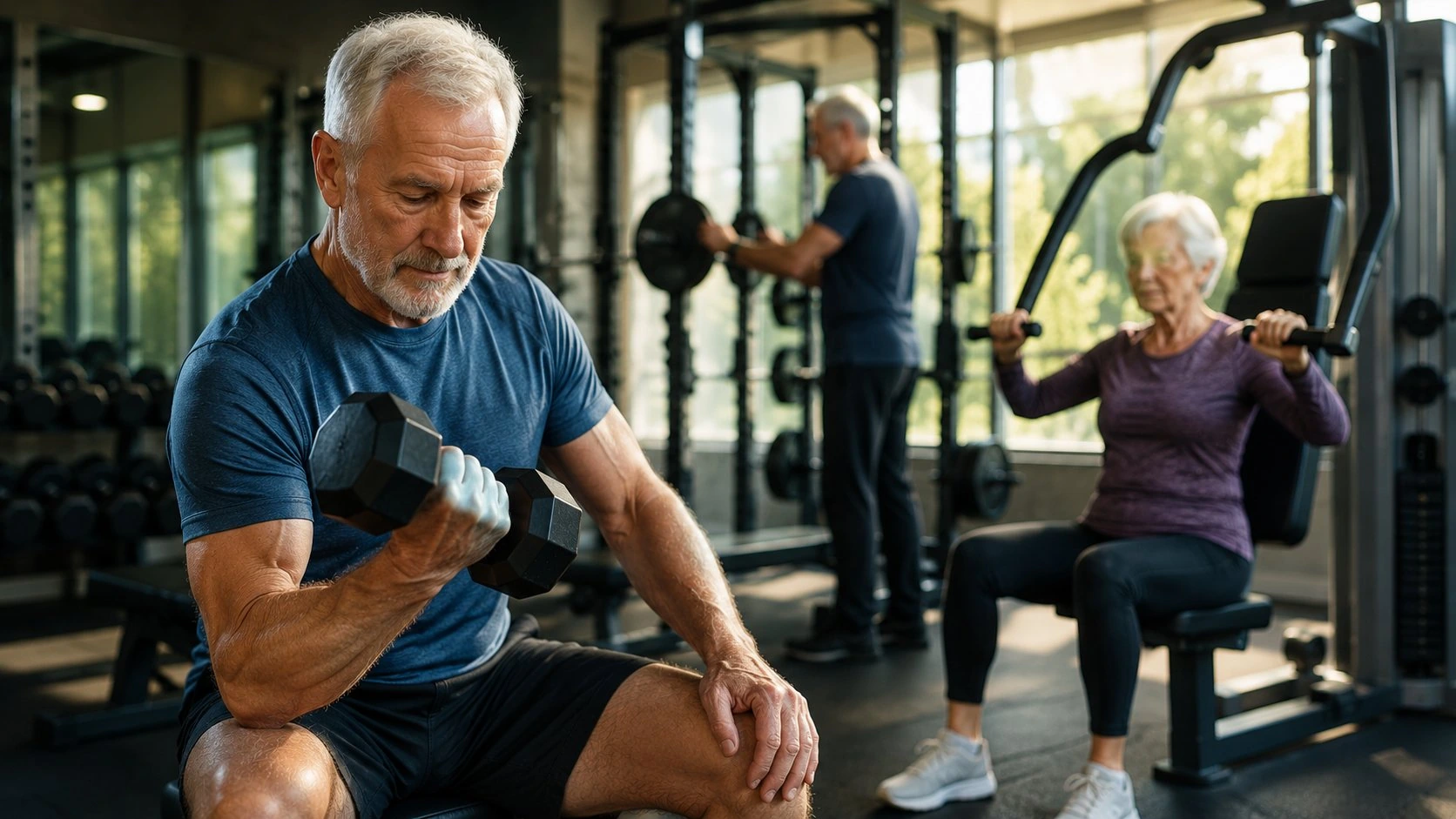
Strength training after 50: 25% adherence, 30% lower mortality.
Strength training after 50 isn't about aesthetics, it's about whether you'll be able to walk independently at 75. BJSM, in a May 2026 editorial, summarised five decades of research into one position: strength training in mature age works as a preventative measure against mortality, functional impairment, diabetes, and mental health disorders. The gap between this science and actual practice is catastrophic.
What does science say about strength training after 50
Strength training after the age of 50 is the most extensively studied intervention for combating sarcopenia. This is the loss of muscle mass and strength that occurs with age, beginning in one’s 30s and accelerating from the age of 60 onwards. Without active intervention, people aged 70 and over often have 30–40% less muscle tissue than they did in their youth.
This isn’t just about looks. Grip strength at the age of 65 is one of the strongest predictors of life expectancy. It is a stronger predictor than blood pressure, cholesterol levels or BMI. The PURE study, involving 140,000 people across 17 countries, showed that every 5 kg reduction in grip strength is associated with a 161% higher risk of death from all causes over a four-year period.
How the mechanism works. Muscle tissue is not just about “lifting heavy things”. It is the largest metabolically active organ in the body. It absorbs glucose, is sensitive to insulin, and produces myokines – signalling molecules that reach the brain, heart, and liver. Less muscle = a higher risk of diabetes, cardiovascular events, and neurodegeneration.
What does the term “strength” include in the context of 50+
Strength training after 50 doesn't necessarily mean barbells. The BJSM editorial includes:
- Classic gym strength training machines (leg press, chest press, rows)
- Dumbbells and barbells
- Bodyweight exercises (squats, modified push-ups, planks)
- Resistance bands (especially relevant for starting at home)
- Calisthenics with progression
What No include as silo in the strict sense:
- Walking, running, swimming – these are cardio, another type of adaptation
- Yoga, pilates — partly, if there's resistance progression, but mainly it's flexibility and stability
- Golf, tennis, badminton are not strength-based, although they are beneficial for other reasons
Minimum per position: 2 times per week, 8-12 repetitions for major muscle groups (legs, back, chest, core). 30-60 minutes per session.
Why is the gap between science and practice so large?
The editors of the BJSM cite specific figures. In most developed countries, between 15% and 25% of people aged 65 and over follow the recommendation to do strength training at least twice a week. Among women aged 65 and over, the figure is often less than 15%. Among people already diagnosed with sarcopenia, it is less than 10%.
It’s a paradox. Medicines that reduce the risk of death by 5–10 per cent are prescribed to millions of people. An intervention that reduces this risk by 20–30 per cent remains a complete outsider.
Why. A number of overlapping reasons:
- The general perception is that “after 50, you need to take care of yourself; strength training is for young people.”
- A shortage of specialists in adult group training – most coaches focus on 25-40 year olds
- Psychological barrier: walking into a gym full of 20-year-olds at 60 is uncomfortable.
- Lack of medical recommendation — in many countries, statins are not included in standard prevention protocols, unlike, for example, statins.
In the Ukrainian context, there's an additional layer. Strength training has long been associated with “bodybuilders” in the culture, and then with the fitness industry for young people. The 50+ audience often lacks both experience and role models.
How to start strength training after 50 from scratch
Not on the recommendation of a friend and not from a YouTube “beginner training for 30 days” program. Safe login algorithm:
- Medical examination. Blood pressure, sugar, heart, joints. If there is untreated hypertension, active phase arthritis, unstable angina – medical control first.
- The first 4-6 weeks are bodyweight exercises. Chair squats to and from, wall push-ups, kneeling planks, step-ups onto a chair. Task: restore neuromuscular control and basic coordination.
- Connect a simple resistor. Resistance bands, light dumbbells (1-3 kg for arms, 5-10 kg for legs via trainers). 2-3 sets of 10-12 repetitions.
- Progression. Every 2-3 weeks, increase either the weight or the number of repetitions. If 12 repetitions are easy, add 1-2 kg or switch to a more difficult version of the exercise.
- Not independently for the first 8-12 weeks. A coach with experience working with adult groups, a physiotherapist, or a “Strength for 50+” group training session offers a significantly lower risk of injury and a better outcome.
A separate point is protein. Without adequate protein, strength training after 50 yields half of the potential result. Details are in the breakdown about Strength and metabolic flexibility 60+.
What does this not solve
Strength training after 50 does not replace aerobic activity. The research is clear: the optimum is a combination. 150 minutes of cardio per week + 2-3 strength sessions. One without the other works less effectively than both together. This is the same principle as in studies about variety of training.
It does not treat existing conditions. If you already have heart failure, severe osteoporosis, or active cancer, the programme must be agreed with your doctors.
It doesn't produce quick results. For a 30-year-old, the first visual changes appear in 4-6 weeks. For a 65-year-old, it takes 3-4 months. This is normal. Adaptation is happening, even if it's not yet obvious in the mirror.
What about the real figures in Ukraine
In Ukraine, there are virtually no large-scale studies on adherence to strength training recommendations for the over-50s. However, indirect data from voluntary surveys and figures from state medical centres suggest even lower figures than in Western countries — around 5–10% of adults aged 65 and over undertake two or more strength training sessions per week.
It's a paradox that a 65-year-old Ukrainian pensioner, on average, has a lower level of adaptation to physical activity than their British or German counterpart. This is despite the fact that demographically, we are ageing faster, and sarcopenia is becoming an even more acute public health problem.
Strength training after 50 in our context is not just “another piece of advice.” It's a fundamental intervention for a population that hardly receives it.
Conclusion: Strength training after 50 as a public health anomaly
The BJSM editorial position for 2026 is not a new scientific finding, but a statement of fact: the mass ignoring of strength training after 50 is a public health scandal that has not yet been recognised as such. The intervention with the best risk-benefit-cost ratio remains marginal.
The best thing you can do for someone aged 50-70 in your family is not to give them the next supplement, but to suggest a joint strength training session once a week. This is the change that science has already proven, but society has not yet noticed.
Sources
- Strength training in older adults: closing the science-practice gap. Br J Sports Med. 2026;60(10):750. (Editorial)
- Leong DP et al. Prognostic value of grip strength: findings from the Prospective Urban Rural Epidemiology (PURE) study. Lancet. 2015;386(9990):266-273. DOI: 10.1016/S0140-6736(14)62000-6
- Fragala MS et al. Resistance Training for Older Adults: NSCA Position Statement. J Strength Cond Res. 2019;33(8):2019-2052. DOI: 10.1519/JSC.0000000000003230




 Українська
  English (UK)