
Grip strength: two tests of strength that predict how long you will live.
Grip strength has turned out to be one of the most accurate predictors of life expectancy. A new study of over 5,000 women has shown: a stronger grip and faster rising from a chair mean a lower risk of death. No treadmills, no blood tests. Two tests that can be done at home.
This isn't about how your muscles look, or about the gym. It's about your body's ability to generate force – and what that ability says about the years ahead.
What did the research show about grip strength?
A team from the University of Buffalo, led by Michael LaMonte, tracked 5,472 women aged 63-99 for an average of 8.4 years. The study was published in JAMA Network Open in February 2026. During this time, 1,964 participants died.
At the start, each underwent two tests. The first was grip strength measured with a hand dynamometer. The second was the time taken to complete five sit-to-stands from a chair without using their hands. These are simple clinical measurements taken in any hospital to assess the condition of elderly patients.
The result is clear-cut. For every additional 7 kg of grip strength, the risk of death was 12% lower on average. For every 6 seconds faster it took to stand up, the risk was 4% lower. It’s a clear correlation: the stronger you are, the longer you live.
How big is the gap between the strong and the weak
The numbers on average look modest. But the gap between the extreme groups is not.
Women in the top quartile for grip strength (over 24 kg) had a mortality rate 33% lower than women in the bottom quartile (less than 14 kg). The picture is similar for the chair stand test: the fastest participants had a risk approximately 34% lower than the slowest.
This isn't the difference between an athlete and a couch potato. It's the difference between two ordinary women over 60, one of whom does a bit of strength training and the other doesn't. Between these two states is a one-third reduction in the risk of death over eight years.
A crucial detail regarding the scale: the average age of the participants was 78.7 years, meaning these were not young women in their prime. The sample was also not homogenous: about a third were Black, a sixth were Hispanic, and the rest were white. And the link held in all subgroups – by age, race, weight, and activity level. This is not an artefact of one demographic, but a consistent pattern.
Why does grip strength predict this at all
Grip strength correlates with overall body strength. The arm weakens along with the rest of the muscles, so a dynamometer serves as an inexpensive indicator of the state of the entire muscular system. Grip also declines during illness, thus serving as an early warning of hidden problems.
The chair test measures something else entirely — leg strength, coordination, and the ability to lift one’s own body against gravity. Interestingly, there is only a weak correlation between these two tests: less than 21% of the total variation. In other words, they measure different things, and each provides its own independent contribution to the prediction.
Muscles are also a metabolic organ. They help to manage insulin levels and affect inflammation. Loss of muscle function and premature death appear to have a common biological driver.
It's worth understanding the pure practical value of these tests. They are fast, cheap, and don't require special equipment — which is why clinics have long used them to assess elderly patients. Grip strength is closely linked to everyday activities: opening a jar, carrying groceries, holding onto a handrail. The chair test directly reflects what determines independence and fall risk — the ability to get up without assistance. The fact that these mundane movements also predict mortality makes them exceptionally informative for their zero cost.
Why isn't it simply «active people live longer»?»
The main discovery isn't the connection itself. It's been shown before. The problem with older research was different: strong people generally move more, sit less, and have healthier hearts. It wasn't possible to untangle strength and activity.
This research has untangled. Researchers took into account physical activity and sitting time using accelerometers. They added walking speed as a measure of cardiorespiratory fitness. They added C-reactive protein – an inflammation marker.
The link between strength and mortality persisted despite all adjustments. What's more: grip strength predicted lower mortality even in women who did not meet the recommended aerobic activity targets. Strength is an independent signal, not a shadow of an active lifestyle. Adjusting for weight and muscle mass also failed to explain the difference.
How to measure and increase grip strength at home
A dynamometer is inexpensive and sold online. But even without one, there are workable guidelines.
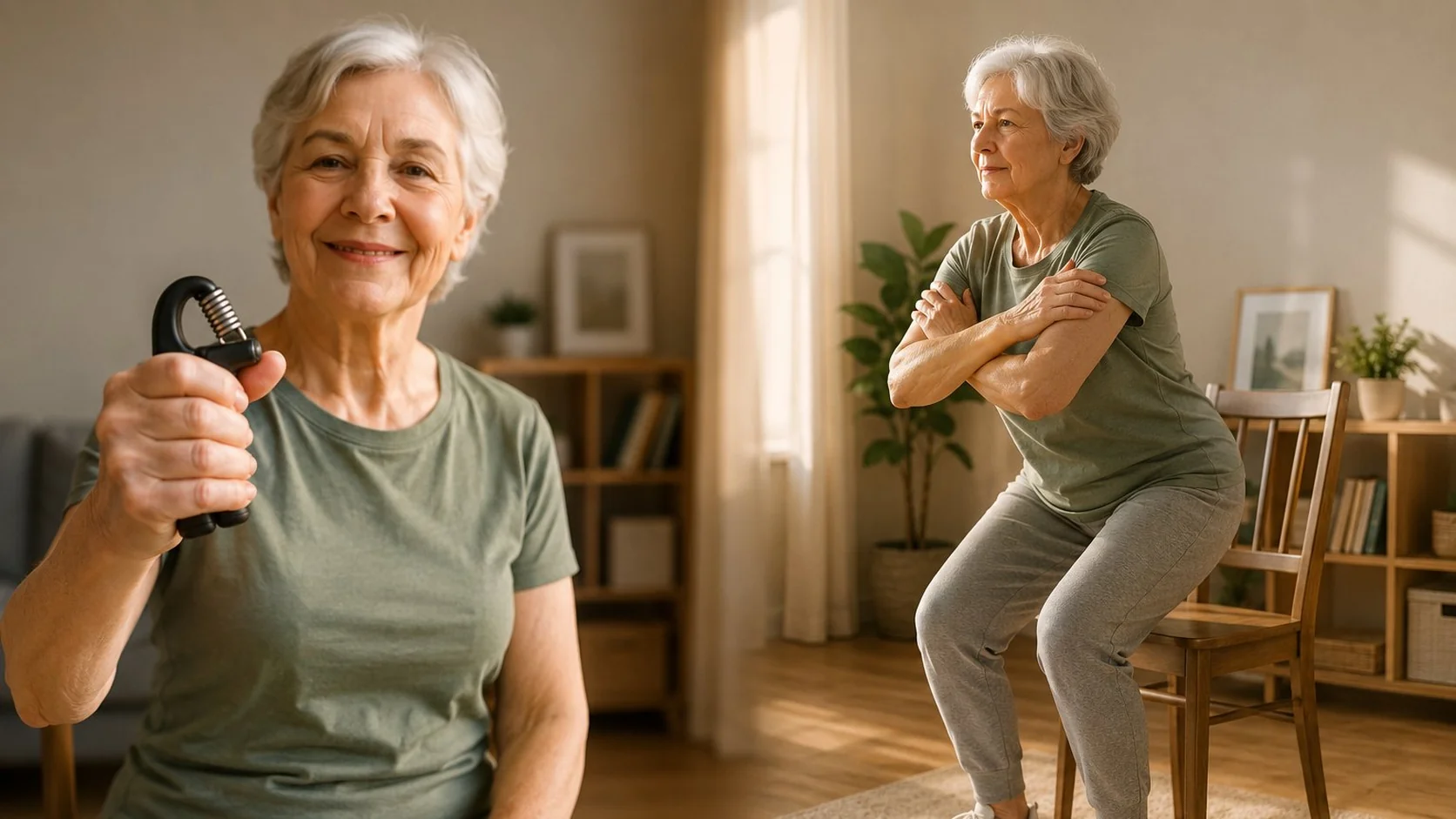
The chair test requires nothing. Sit in a standard-height chair with your arms crossed over your chest. Stand up and sit down five times as quickly as possible without using your hands. Time yourself. In the study, faster results consistently meant a lower risk – every 6 seconds counted.
For grip, a household marker is simple. Opening a tight jar, carrying heavy bags without rest, holding your own weight on a pull-up bar for at least a second. If this is noticeably harder than a year ago, it's a signal, not a minor issue.
The good news is that strength can be built at any age. And resistance doesn't have to be a barbell. Tins of beans, water bottles, books in a bag – these are all weights. Getting up from a chair can be turned into an exercise: a few reps a day, gradually faster. Squeezing a ball or a hand grip trainer works your grip directly. Researchers have specifically mentioned household items as legitimate resistance for starting out.
[Here is a personal detail – your approach to strength training or a story about a specific person aged 60+]
The logic is as follows: to walk, you need to be able to stand up. If you don't have the strength to get up from a chair, aerobic exercises automatically become inaccessible. Strength is the foundation upon which all other activity rests, not an addition to cardio.
And what about men and younger people?
The study concerned women aged 63 and over, and this is its limit: formally, it draws no conclusions about men or people in their 40s. However, the mechanism is universal and this is not the first time it has emerged in data.
The most significant confirmation comes from the PURE study, which tracked almost half a million people in 17 countries. There, grip strength was found to be a stronger predictor of mortality than systolic blood pressure: every 5 kg loss in grip increased the risk of death from all causes. A separate dose-dependent meta-analysis from 2022 confirmed grip thresholds for all-cause mortality, cancer, and cardiovascular events.
So grip works as an indicator regardless of gender and cohort. A 2026 study on women added a key point to this – it proved that the signal is independent and doesn't mask an active lifestyle.
One-sentence conclusion
Grip strength and chair stand time are two free tests that tell you more about your age than you might think, and the strength they measure can be built with a tin of beans just as well as a gym membership.
More about why strength training after 50 is no less important than cardio – in our Training strategies after 50.
Sources
- LaMonte MJ, Hyde ET, Nguyen S, et al. Muscular Strength and Mortality in Women Aged 63 to 99 Years. JAMA Network Open. 2026;9(2):e2559367. DOI: 10.1001/jamanetworkopen.2025.59367
- Leong DP, Teo KK, Rangarajan S, et al. Prognostic value of grip strength: findings from the Prospective Urban Rural Epidemiology (PURE) study. The Lancet. 2015;386(9990):266-273. DOI: 10.1016/S0140-6736(14)62000-6
- López-Bueno R, Andersen LL, Koyanagi A, et al. Thresholds of handgrip strength for all-cause, cancer, and cardiovascular mortality: a systematic review with dose-response meta-analysis. Ageing Research Reviews. 2022;82:101778. DOI: 10.1016/j.arr.2022.101778




 Українська
  English (UK)