-
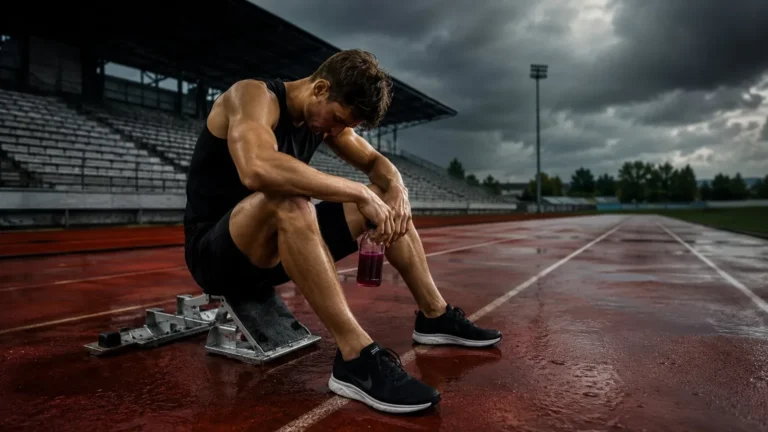
Beetroot juice did not make sprinters faster: 12 athletes, zero effect.
Beetroot juice has been sold for years as a legitimate boost for explosiveness and speed. A new randomised experiment tested this on trained sprinters. Nitrates in their saliva rocketed up 27-fold. 100-metre times did not budge. This is further proof of a simple thesis: «working biochemistry» and «working supplement» are different things. And a reason to look into who beetroot juice is really needed for...
-
Exercise gut microbiome: why intensity matters more than just movement.
Exercise gut microbiome — a link long thought to be straightforward: move more, and your gut bacteria will become «better». A fresh analysis in Gut Microbes (November 2025) reveals a detail usually missed by health marketing. It's not just about moving, but the intensity of that movement. Reljic's team, with co-authors, collated three randomised trials and compared high-intensity exercise with moderate. The result...
-
Probiotics and sleep: 6 studies on whether gut bacteria improve sleep.
Probiotics for sleep isn't just a marketing label from a yoghurt pot. It's a field where enough randomised studies have amassed in recent years to ask a genuine question. Can gut bacteria really improve sleep? A fresh systematic review in the Journal of the International Society of Sports Nutrition (May 2026) compiled 6 RCTs. The authors looked at what happens to...
-
BCAA endurance: 15 studies, no consistent effect on endurance.
BCAA endurance is a combination around which an entire sports nutrition industry has been built. A recent systematic review shows there is almost no evidence for it. The Del Guerra team and co-authors analysed 15 studies using the PRISMA 2020, Cochrane, and GRADE methodologies. The conclusion is straightforward: branched-chain amino acids do not provide a significant increase in either performance or recovery for runners and cyclists. Biochemistry in...
-
Mental fatigue stole your repetitions, and you thought it was laziness.
Mental fatigue — that mental exhaustion you feel after a Stroop test, scrolling through your feed, or a hard day’s work. And on average, it reduces your strength training volume by around 8%. This isn’t just a subjective feeling, but a figure from a new meta-analysis of 11 randomised controlled trials. And what suffers most is not what you might expect: not your maximum weight, but your usual working sets at 60–79% of your maximum. Fresh…
-
White matter: Why physical activity rewrites the brain after 50.
White matter — the brain's white matter — is not a passive cable between neurons. It's a tissue that movement can remodel, even in old age. A new longitudinal study from May 2026 tracked 715 adults. It revealed a simple, yet counterintuitive, finding: the brain doesn't just degrade with age; it reorganises. And physical activity drives this remodelling. Sounds like an Instagram slogan...
-
Sedentary behaviour: every hour spent sitting increases the risk of stroke by 51%.
A sedentary lifestyle costs more than it seems. A recent study of 37,385 adults has calculated the exact cost. Every additional hour of sitting per day increases the risk of stroke by 51%. And those who sit for eight hours or more have a 53% higher risk. Below — what exactly was measured, how this works and…
-
The Mediterranean diet is insufficient: why without exercise it works twice as weakly.
The Mediterranean diet has long been considered the gold standard for healthy eating. But the largest European nutrition study revealed an inconvenient detail. On its own, it works, but when paired with exercise and a slight calorie deficit, it's a third stronger against diabetes. The diet turned out to be a foundation, not a complete solution. It's not «what to eat» instead of «how to move.» It's about how one without...
-
Grip strength: two tests of strength that predict how long you will live.
Grip strength has turned out to be one of the most accurate predictors of lifespan. A new study of over 5,000 women has shown that a stronger grip and faster rising from a chair mean a lower risk of death. No treadmill, no blood tests. Two tests that can be done at home. It's not about the look of muscles or the gym. It's about…



 Українська
  English (UK)