
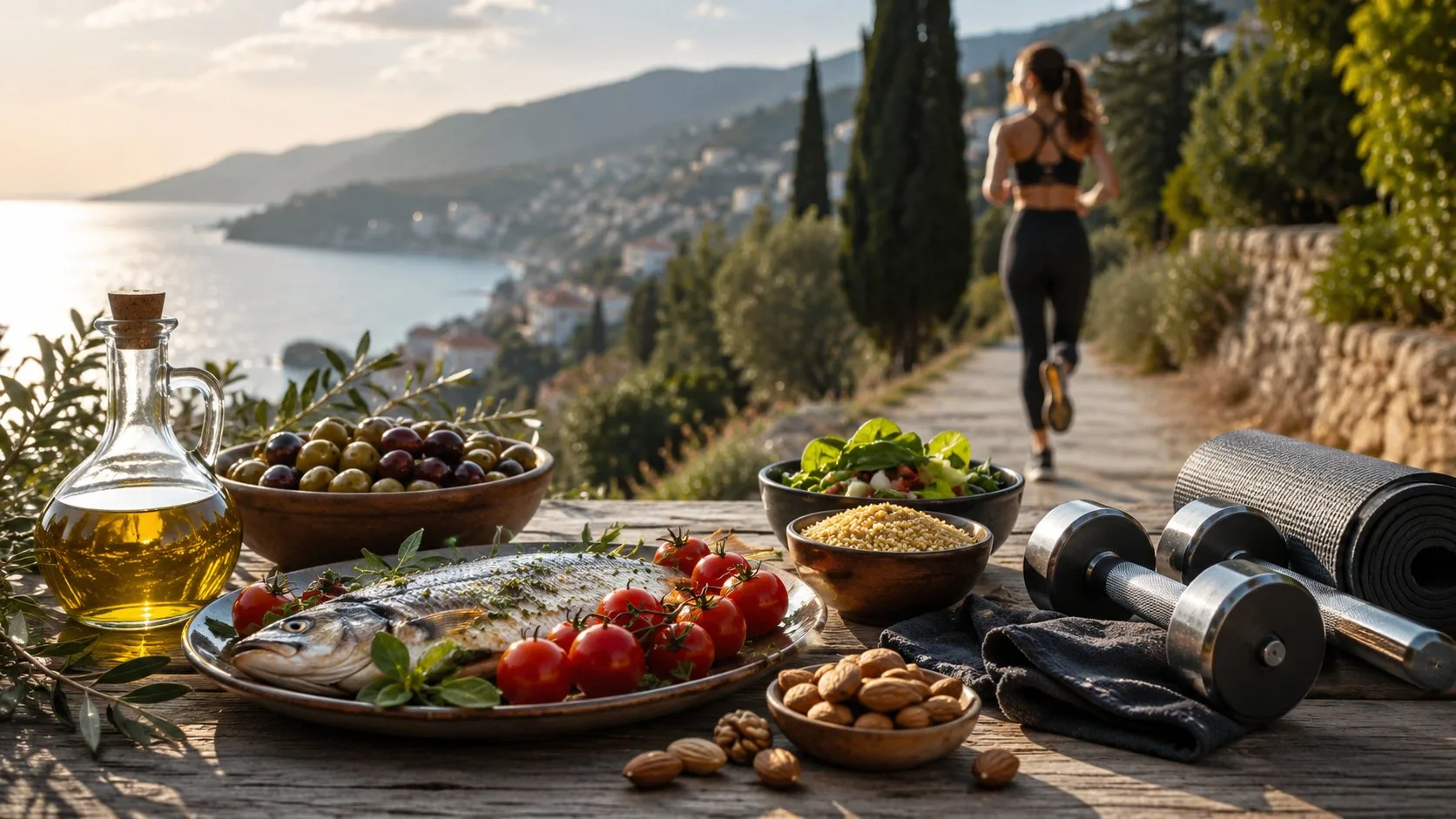
The Mediterranean diet is insufficient: why without exercise it works twice as weakly.
The Mediterranean diet has long been considered the benchmark for healthy eating. However, the largest European nutrition study has revealed an inconvenient detail. On its own, it works, but when combined with exercise and a slight calorie deficit, it is a third more effective against diabetes. The diet turned out to be a foundation, not a complete solution.
This isn't about «what to eat» instead of «how to move». It's about how one without the other leaves half the effect on the table.
The study showed that the Mediterranean diet is associated with a reduced risk of heart disease and stroke.
The Spanish PREDIMED-Plus study is the largest nutritional experiment in European history. It included 4,746 adults aged 55-75 who were overweight or obese and had metabolic syndrome. None had diabetes or cardiovascular disease at the start. The observation lasted approximately six years.
The participants were divided into two groups. The first group ate a Mediterranean diet without calorie restrictions and without a training plan – this was the control group. The second group received the same diet but with a deficit of about 600 kcal per day, a progressive activity plan and coaching for weight control.
The results were published in the Annals of Internal Medicine in 2025. The gap between the groups turned out to be larger than expected.
Key figure: −31% diabetes risk
The group following a calorie-restricted diet combined with exercise had a 31% lower relative risk of developing type 2 diabetes than the group on a free-choice Mediterranean diet.
The most interesting thing is that both groups essentially ate the same food. The only differences were in portion sizes, physical activity and support. In other words, −31% is not about the food itself, but about the structure: fewer calories, more activity and regular support.
It's worth reading this figure correctly. It's a relative risk reduction, not a guarantee for everyone. If the conditional baseline risk of diabetes in the group was a certain percentage, the intervention cut almost a third of it. At the population level, this means thousands of averted cases, as type 2 diabetes is a widespread and largely preventable disease.
The curves for the two groups began to diverge within the first six months. The effect did not accumulate over the years – it appeared quickly and then persisted for the entire duration.
This result has a backstory. The original PREDIMED study showed earlier that a Mediterranean diet with olive oil or nuts reduces cardiovascular risk. But there, the benefit appeared without significant weight loss. PREDIMED-Plus posed the following question: does adding a calorie deficit and exercise to the same diet enhance the effect? The answer is yes, and this is most clearly seen with diabetes.
What happened to your weight and waist
The scales' numbers visually explain the mechanism.
The deficit and movement group lost an average of 3.3 kg and reduced their waist circumference by 3.6 cm. The control group on a free diet lost only 0.6 kg and 0.3 cm. This is more than a fivefold difference in weight loss between the two «healthy eating» options.
Waist circumference isn't just cosmetic. Abdominal fat is directly linked to insulin resistance – the main mechanism that leads to diabetes. A smaller waist means less metabolically active visceral fat.
Visceral fat – the fat that surrounds internal organs – behaves like a separate endocrine organ. It releases inflammatory signals and free fatty acids that disrupt insulin's function. Therefore, even a modest 3.3 kg, if it's primarily from the abdomen, has a disproportionately large metabolic effect. This explains why a seemingly small weight loss resulted in a one-third reduction in the risk of diabetes.
Why the Mediterranean diet works less effectively without exercise
The mechanism described by the authors is simple. The Mediterranean diet acts synergistically: it improves insulin sensitivity and reduces inflammation. However, caloric deficit and physical activity enhance these effects.
Exercise expends glucose and makes muscles more receptive to insulin, irrespective of food intake. A calorie deficit compels the body to burn reserves, particularly visceral fat. Diet provides the quality of fuel. Exercise and deficit set the direction in which this fuel is utilised.
Individually each factor is weak. Together they form a system where the effect is greater than the sum of its parts. This is why the control group, which ate just as well, achieved a significantly lower result. The quality of food without energy expenditure and a calorie deficit simply has nowhere to be utilised.
Why this isn't another «miracle diet»
The strength of the research lies in the realism of the changes. The 600 kcal deficit is moderate, and the activity is progressive, without extremes. This is not starvation or marathon training.
More importantly, adherence. Participants maintained the changes for six years with very low attrition. One external commentator called this the most impressive detail. People really changed their lifestyle for the long term, not just for a month before summer.
[personal detail—your experience with sustainable changes in diet or exercise]
This is what sets the result apart from typical dieting promises. It's not the diet itself that works, but a sustainable lifestyle where food, movement, and support go hand in hand. The age group is also worth understanding: participants were aged 55-75, overweight, and had metabolic syndrome. This means young, healthy people weren't involved, but specifically the group for whom the risk of diabetes is real and close.
What to do with this
A practical conclusion doesn't require rewriting one's entire life.
If the Mediterranean style is already familiar, the next step isn't a new list of products. I'll remind you of the basics: more fruits, vegetables, fish, olive oil, whole grains, less red meat and sugar. The change is elsewhere – in two things on top of this base: a slight calorie deficit and regular exercise.
A deficit of 500-600 kcal is noticeable but not exhausting. This is roughly one to two smaller portions a day, not starvation. Activity involves aerobics plus a bit of strength and balance, gradually increasing the volume. This progression was exactly what was in the study, and it's precisely what gave the gap in weight and risk.
Another point is support. The study included coaching, and this is not a trivial detail. Regular external guidance dramatically increases the chances of sustaining changes for years. This could be a coach, a doctor, or even a structured app. It's harder to maintain consistency on your own, and the data confirms this.
A separate parallel: when weight is lost pharmacologically, the question also arises as to what exactly is lost – fat or muscle. More on this in Discussion about muscle loss on Ozempic.
One-sentence conclusion
The Mediterranean diet is the foundation, not the roof. It is beneficial in its own right, but it only reduces the risk of diabetes by 31% when combined with a moderate calorie deficit and regular exercise.
Sources
- Ruiz-Canela M, Corella D, Martínez-González MÁ, et al. Comparison of an energy-reduced Mediterranean diet and physical activity versus a Mediterranean diet ad libitum in the prevention of type 2 diabetes: a secondary analysis of a randomised controlled trial. Annals of Internal Medicine. 2025;178(10):1378-1389. DOI: 10.7326/ANNALS-25-00388
- Estruch R, Ros E, Salas-Salvadó J, et al. Primary Prevention of Cardiovascular Disease with a Mediterranean Diet Supplemented with Extra-Virgin Olive Oil or Nuts. New England Journal of Medicine. 2018;378:e34. DOI: 10.1056/NEJMoa1800389
- Salas-Salvadó J, Díaz-López A, Ruiz-Canela M, et al. Effect of a Lifestyle Intervention Program With Energy-Restricted Mediterranean Diet and Exercise on Weight Loss and Cardiovascular Risk Factors: One-Year Results of the PREDIMED-Plus Trial. Diabetes Care. 2019;42(5):777-788. DOI: 10.2337/dc18-0836






 Українська
  English (UK)