
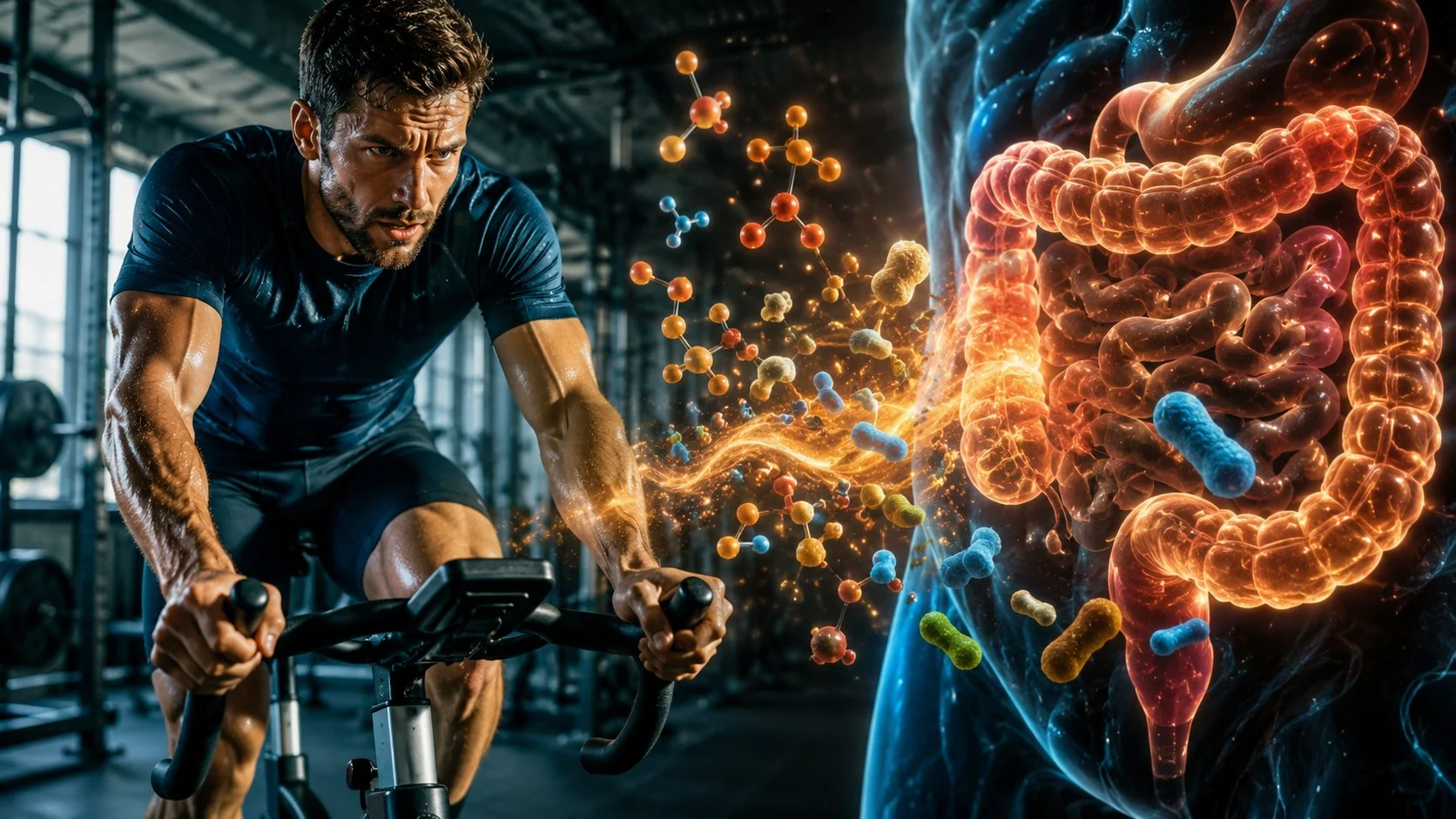
Exercise gut microbiome: why intensity matters more than just movement.
Exercise gut microbiome — a link long thought to be simple: move, and the bacteria in your gut will become «better.» A recent analysis in Gut Microbes (November 2025) reveals a detail that health marketing typically misses. What matters is not the act of moving itself, but its intensity.
The Reljic team and co-authors reviewed three randomised trials and compared high-intensity training with moderate-intensity training. The result is clear: only high-intensity training offered benefits for gut metabolites. This is important because most advice about exercise and the gut microbiome sounds like «just move more» – without specifying how. It turns out that «how» is everything. Below, we will examine what the numbers showed and the limitations of the conclusions.
The study showed that exercise has a significant impact on the gut microbiome.
This is a pooled analysis of data from three RCTs involving 113 patients with obesity and metabolic syndrome. All trained for 12 weeks, twice a week, for approximately 34 minutes per session. The format was low-volume: short intervals on a cycle ergometer plus one set of resistance exercises for major muscle groups.
The participants were divided into three groups. HIGH-EX — high-intensity intervals (up to 90–95% of maximum heart rate). MOD-EX — moderate intensity (65–79% of heart rate). CON — control group with no exercise, diet only. All groups reduced their calorie intake equally under the supervision of a dietitian.
The main dimension is the concentration of short-chain fatty acids in faeces. These are metabolites that bacteria produce from fibre. It is they, rather than the «flora composition» in general, that are most strongly associated with metabolic health.
The results are striking. Only the HIGH-EX group showed an increase in total short-chain fatty acids — by 30%. Acetate increased by 27%, propionate by 28%, and butyrate by 43%. There were no significant changes in the MOD-EX and CON groups. Intensity proved to be the deciding factor, rather than a minor detail.
It is worth highlighting the context. Both training groups improved their physical fitness: VO₂max increased by 4.2 ml/kg/min in the HIGH-EX group and by 2.7 ml/kg/min in the MOD-EX group. Strength in the major muscle groups increased by 19–291 TP6T in both groups. Blood pressure and inflammation (hsCRP) also decreased in both groups. In other words, according to «classic» health indicators, moderate training did not lag critically behind. The difference was evident specifically in gut metabolites — and only there.
Why are short-chain fatty acids important?
To understand the result, one needs to know why these metabolites are needed. Short-chain fatty acids – acetate, propionate, and butyrate – are the «currency» with which gut bacteria pay the body for fibre.
Butyrate is fuel for the cells lining the gut. It strengthens the intestinal barrier and has an anti-inflammatory effect. When butyrate is low, the barrier weakens and chronic inflammation increases. In people with obesity, butyrate levels are often reduced.
Propionate affects the liver and satiety signals via the gut-brain axis. Acetate is the most common, it fuels metabolism and serves as a precursor for butyrate synthesis. Together, these three regulate insulin sensitivity, lipid metabolism, and inflammation.
Therefore, the increase in these metabolites in 30% is not just an abstract laboratory figure. It represents a shift towards a better metabolic profile, which is particularly valuable for people with metabolic syndrome.
Butyrate deserves special mention, as it has seen the sharpest increase – by 43%. Butyrate acts as an anti-inflammatory agent and a metabolic regulator. It works through two mechanisms: the inhibition of deacetylase enzymes and the activation of specific receptors on cells. Put simply, it is not just «fuel», but a signalling molecule that tells the body to reduce inflammation. For someone with metabolic syndrome, where chronic low-grade inflammation is part of the problem, this is exactly the right approach.
The mechanism of exercise on the gut microbiome: what does lactate have to do with it
The most interesting thing about the study is the explanation of why intensity worked. The answer is lactate.
During intense exercise, muscles produce a lot of lactate. In HIGH-EX, the average lactate during intervals was 8.7 mmol/L, whereas in MOD-EX, it was only 4.1. This is more than double.
And here's the key: the lactate level during training strongly correlated with the increase in metabolites (r = 0.68, p < 0.001). The more lactate, the greater the increase in short-chain fatty acids.
The hypothesis is as follows. Lactate, produced by muscles, becomes a raw material for certain bacteria. Species like Anaerostipes and Eubacterium hallii convert lactate into butyrate. This means a muscle metabolite becomes food for microbes, which in turn give back beneficial butyrate. This «lactate-SCFA link» is still a hypothesis, but the data fits it well.
This doesn't prove it
We need a sober approach here, otherwise the exercise gut microbiome will just become another flashy headline.
Firstly, the composition of bacteria was not directly measured. Researchers observed metabolites in faeces but did not sequence which specific species produced them. Therefore, the «lactate-SCFA link» is a logical explanation, not a proven chain.
Secondly, faecal short-chain fatty acids are what's left in the gut, not what the body has absorbed. Most of these acids are absorbed quickly. Therefore, the faecal level may underestimate the actual production.
Thirdly, the sample group consisted of people with obesity and metabolic syndrome. The conclusion cannot be directly applied to a healthy runner. The effects of exercise on the microbiome in slender individuals are sometimes different. Therefore, the statement «exercise gut microbiome improves with intensity» is accurate specifically for this population, not for everyone.
And 12 weeks is a short period. Whether the effect lasts after discontinuation or continues to accumulate is unknown. Moreover, this is a secondary analysis of three different studies, combined together. The authors justified such a combination, but heterogeneity between the initial protocols still adds uncertainty. They honestly write about this.
Why is fibre control crucial here?
One aspect makes this study particularly compelling. All three groups ate the same amount of fibre – it remained unchanged over the 12 weeks in any of them.
This is important because fibre is the main source of short-chain fatty acids. If HIGH-EX had simply eaten more vegetables, the increase in metabolites could have been attributed to diet. But fibre was stable everywhere.
So, the difference wasn't down to diet, but specifically to the intensity of the movement. This is a rare case where the design allows for the separation of the effect of exercise from the effect of food. For the topic of the exercise gut microbiome, this is a strong argument: movement affects microbial metabolites regardless of what's on the plate. Most microbiome studies get confused right here – both diet and activity change, and it's impossible to say what worked. Here, fibre was kept stable deliberately, and this adds weight to the conclusion.
What to do with this in practice
The practical takeaway is not «run until you drop every day.» It's more nuanced.
If the goal is metabolic health and gut metabolites, moderate pace might not be sufficient. Short intense intervals appear more effective for this specific outcome. And this isn't hours in the gym: the protocol took ~34 minutes twice a week. The «no time» argument doesn't work here – the volume was low, intensity high.
At the same time, moderate training is not pointless. In the MOD-EX study, it also improved pressure, inflammation, strength, and VO2max – simply without an increase in short-chain fatty acids. For someone who is just starting out or has contraindications to intense training, moderate is a sensible entry point. It's a foundation upon which intensity can be added later.
Interestingly, this logic echoes the effect of sprint intervals on insulin sensitivity – something we wrote about in our analysis, where A smaller volume of work gave a greater metabolic effect. And if you're interested in the microbiome more broadly, we've also covered the opposite side — Can probiotics improve sleep via the same gut-brain axis. [personal detail here - did Vitaliy feel the difference between interval training and steady-state cardio]
Summary in one sentence
Exercise affects the gut microbiome not simply through the act of movement itself, but through its intensity: in people with metabolic syndrome, only high-intensity training increased beneficial gut metabolites by 30%, presumably due to lactate, whereas moderate exercise improved other health indicators but had no effect on microbial acids. The simple conclusion for practice is this: if you want exercise to have a real impact on the gut microbiome, focus on intensity rather than duration. Short, high-intensity intervals are more important here than long, steady-state sessions. At least for gut metabolites and people at metabolic risk.
Sources
- Reljic D, Hermann HJ, Dieterich W, et al. Exercise improves gut microbial metabolites in an intensity-dependent manner: a pooled analysis of randomised controlled trials. Gut Microbes. 2025;17(1):2579354. DOI: 10.1080/19490976.2025.2579354
- Liu Y, Wang Y, Ni Y, et al. Gut Microbiome Fermentation Determines the Efficacy of Exercise for Diabetes Prevention. Cell Metabolism. 2020;31(1):77-91. DOI: 10.1016/j.cmet.2019.11.001
- Min L, Ablitip A, Wang R, et al. Effects of Exercise on Gut Microbiota of Adults: A Systematic Review and Meta-Analysis. Nutrients. 2024;16(7):1070. DOI: 10.3390/nu16071070






 Українська
  English (UK)