
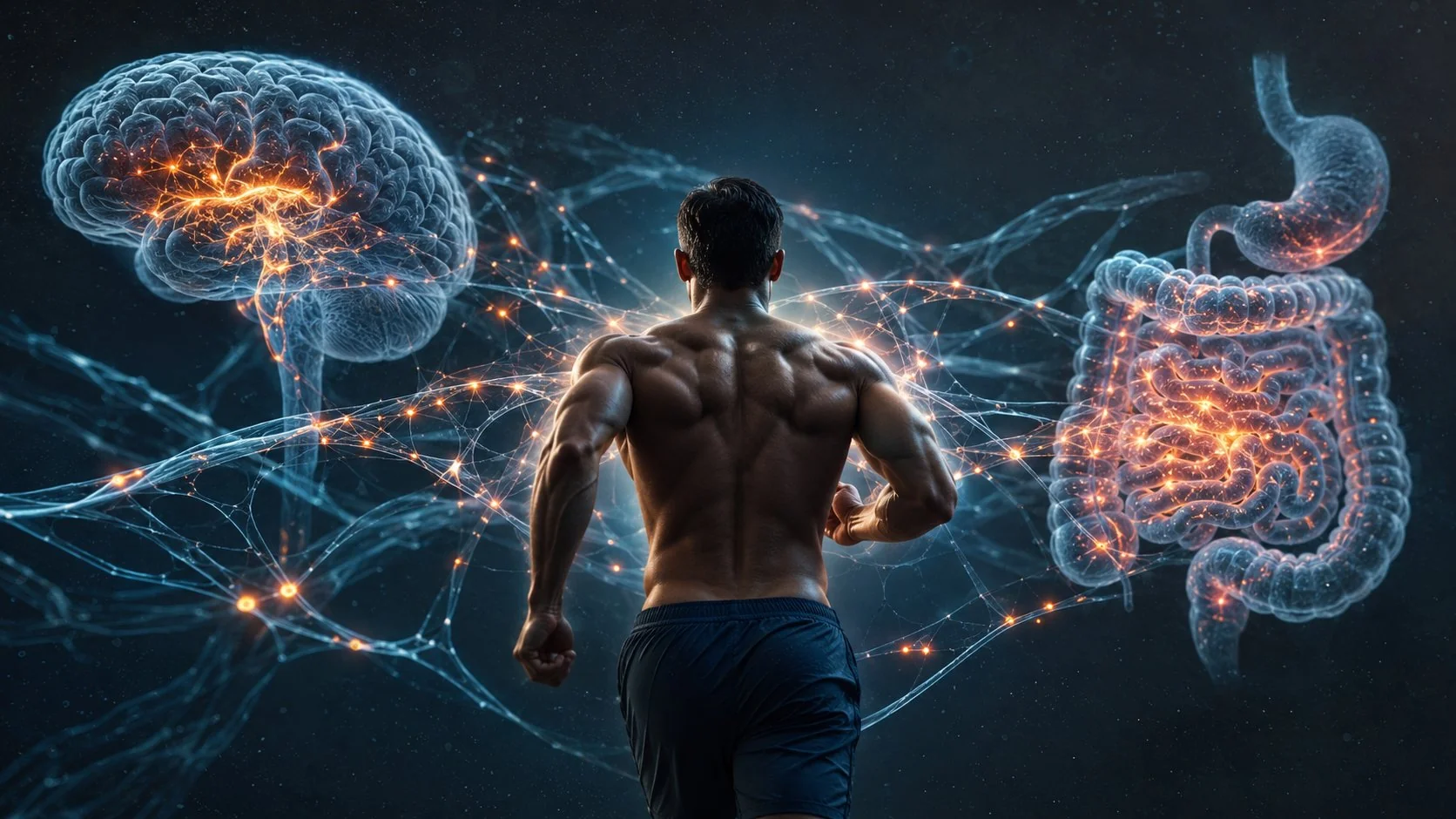
Muscle-brain axis: 154 studies, 987 connections, and only 59 reliable.
The muscle-brain axis is the idea that working muscle communicates with the brain in chemical language. A systematic review in Molecular Biology Reports collected 154 studies and 987 molecular connections between muscles, the brain, and the gut. Of these, the authors deemed only 59 to be reliable. This is a good opportunity to explore what is science here and what is still hypothesis.
The muscle-brain axis is a connection between your muscles and your brain. Your muscles don't just move your body; they also send signals to your brain. These signals can affect your mood, memory, and how well your brain works. When you exercise, your muscles release chemicals that are good for your brain. This connection helps to keep both your body and your mind healthy.
Classical physiology viewed organs in isolation. A muscle contracts, the brain commands, the gut digests. The muscle-brain axis overturns this picture. Skeletal muscle here is not just a mover. It is a secretory organ that releases signalling proteins during contraction. These act on other tissues, particularly the brain.
Hoseini and colleagues' review (2026) described the muscle-brain axis as a three-node system: muscle, brain, and gut microbiota. Signals travel in all directions. Proteins from muscles reach the hippocampus. Bacterial metabolites affect inflammation and mood. And psychological state changes the composition of the microbiota itself. It's not a line, but a triangle.
Why is this important for the average person, not just physiologists? Because it is this perspective that explains why movement has such a broad effect. One workout doesn't just affect one organ, but a whole network. And this changes how we should think about the benefits of activity.
Myokines: Chemical letters from muscle to brain
Proteins secreted by contracting muscle are called myokines. The term was introduced by Bente Pedersen's team in the 2000s. At that time, it was discovered that muscle releases interleukin-6 into the bloodstream during exercise. Since then, the list has grown to hundreds of candidates. Each such protein is like a chemical letter that the tissue sends to the entire body.
In the context of the muscle-brain axis, a few key players are worth noting. Interleukin-6 regulates inflammation and glucose metabolism. BDNF is a neurotrophic factor that supports neuron survival. FNDC5, from which irisin is formed, is linked to fat metabolism and brain function. These are the molecules most often mentioned when explaining why physical activity improves memory and mood.
It's important to understand the scale of things. Discovering that a molecule increases after exercise is just the first step. Proving that it actually reaches the brain and changes something there is much more difficult. Most myokines get stuck at this stage.
Another subtlety is the number of candidates themselves. Modern methods allow for the measurement of thousands of proteins simultaneously, so the list of «potential myokines» swells faster than verification can keep up. Finding a correlation is easy. Separating random matches from genuine signals is years of work. This is precisely why the review contains so many links, but so few reliable ones.
BDNF and memory: the strongest link
If there is one connection throughout the axis that has withstood the most testing, it is BDNF. The work of Wrann and colleagues (2013, Cell Metabolism) demonstrated a mechanism. Exercise triggers the PGC-1α/FNDC5 pathway in the muscle. This increases BDNF in the hippocampus – the area responsible for memory.
This was further confirmed in humans. Research by Erickson and colleagues (2011, PNAS) showed an effect in the elderly. Aerobic exercise increased hippocampal volume and improved memory. A study by Lourenco and colleagues (2019, Nature Medicine) went deeper. The FNDC5/irisin pathway restored synaptic plasticity in Alzheimer's disease models. Here, the muscle-brain axis ceases to be an abstraction and becomes a measurable effect.
Why is this link strong? Because it has been tested from different angles: in cells, in animals, and in humans. When the conclusion is repeated across three different types of research, it is justifiable to trust it. This is a rare occurrence across the entire axis.
The gut as a third player
Why did the gut even appear in the brain-gut axis? Because bacteria inside us produce chemicals that act on the same targets. When microbes ferment fibre, short-chain fatty acids (SCFAs) are formed: butyrate, propionate, acetate. They affect inflammation, mitochondria, and even the brain barrier.
The second channel is tryptophan. From this amino acid, bacteria and the body build serotonin and other active compounds. A review by Agus and colleagues (2018, Cell Host & Microbe) described how the microbiota controls this metabolism. And the work of Lahiri and colleagues (2019, Science Translational Medicine) showed a direct link. Mice without microbiota had weaker muscles, and the transplantation of bacteria partially restored strength. The gut affects not only the brain but also the muscle in return.
This node is the least understood. Most of the data here is from mice, not humans. You can read about how supplements actually affect sleep and recovery through the microbiota in our review of research on probiotics and sleep. In short: the effect is there, but weaker than advertised.
The microbiota of elite athletes and the muscle-brain axis
One of the most cited pieces of evidence for the axis is the work of Scheiman and colleagues (2019, Nature Medicine). The team analysed the microbiota of runners in the Boston Marathon. They found bacteria of the genus Veillonella that multiplied more actively after the run. In mice, these bacteria increased endurance. The mechanism is elegant: they processed lactate - a byproduct of exertion - into a useful substrate.
This does not mean that a pill with bacteria will make you a marathon runner. But it shows a direction. The composition of the microbiota in trained people is indeed different, and part of this difference is functional rather than random. It is precisely such findings that fuel interest in the muscle-brain axis as a system that can be controlled.
Why is this an important detail for understanding the whole axis? Because it shows the two-sidedness. It's not just muscles and the brain that influence the gut through movement. Bacteria also give back and support muscle function during exertion. In the muscle-brain axis, the triangle is completed.
Why 952 out of 987 connections were weak
Now for the main point, the reason why it's worth reading the original source rather than the headlines. The review identified 987 molecular associations. The authors recognised only 59 as robust – at evidence levels 1-2. The remaining 952 fell short due to weak methodology or a lack of mechanistic depth.
This is precisely the honest picture of the muscle-brain axis in 2026. The core framework of the muscle-brain axis stands firm. Muscles release myokines, the microbiota produce metabolites, and both influence the brain. However, most of the specific arrows on the nice diagrams are hypotheses rather than laws for now. It's useful to keep this in mind when the next blog promises to «activate the muscle-brain axis» with a single supplement.
A good illustration of caution is the story of irisin. Its discovery in 2012 (Boström et al., Nature) was presented as a breakthrough: a myokine that turns white fat into brown. But already in 2015, a paper by Albrecht et al. (Scientific Reports) was published. Irisin was called more of a myth in it due to problems with measurement methods. Today, the position is more balanced: it exists and has effects, but weaker and narrower than initially promised. More details on the link between irisin and the hippocampus can be found at Posts about how movement reaches the brain.
How to support the muscle-brain axis in practice
The practical conclusion is simple and needs no additions. Regular exercise is the only reliable way to activate the entire axis at once. Muscles release myokines during activity. A varied diet with fibre feeds bacteria that produce SCFAs. Sleep and stress management keep the HPA axis, which is also intertwined in this system, in check.
No single pill can replicate this effect. Neither a probiotic nor a «brain» supplement hits all three nodes at once – they only affect one. Therefore, the marketing of a standalone «muscle-brain axis» tablet is like selling one arrow instead of the whole network. [personal detail here – your training and nutrition regime]. The strength of the muscle-brain axis lies precisely in the fact that movement triggers all links together.
What does this mean in practical terms? Combining strength and aerobic training provides the widest range of signals. Fibre from vegetables, legumes and whole grains is fuel for beneficial bacteria. And sufficient sleep completes the circle, because without recovery, none of these mechanisms work at full potential. This isn't a complex formula, and it contains no exotic ingredients.
The muscle-brain axis is a real system with a strong framework and many unfinished details, and while science fills in those gaps, the best thing to do for it is simply to move.
Sources
- Hoseini R, Hoseini Z, Heydarpour B, Faraji M. A systematic review of molecular signalling in the muscle–brain–gut axis: exercise-induced myokines and microbial metabolites as key mediators. Molecular Biology Reports. 2026;53(1):880. DOI: 10.1007/s11033-026-12035-y
- Wrann CD, White JP, Salogiannnis J, et al. Exercise induces hippocampal BDNF through a PGC-1α/FNDC5 pathway. Cell Metabolism. 2013;18(5):649-659. DOI: 10.1016/j.cmet.2013.09.008
- Lourenco MV, Frozza RL, de Freitas GB, et al. Exercise-linked FNDC5/irisin rescues synaptic plasticity and memory defects in Alzheimer’s models. Nature Medicine. 2019;25(1):165-175. DOI: 10.1038/s41591-018-0275-4
- Lahiri S, Kim H, Garcia-Perez I, et al. The gut microbiota influences skeletal muscle mass and function in mice. Science Translational Medicine. 2019;11(502):eaan5662. DOI: 10.1126/scitranslmed.aan5662
- Scheiman J, Luber JM, Chavkin TA, et al. Meta-omics analysis of elite athletes identifies a performance-enhancing microbe that functions via lactate metabolism. Nature Medicine. 2019;25(7):1104-1109. DOI: 10.1038/s41591-019-0485-4






 Українська
  English (UK)