
Irisin: the molecule through which movement reaches the hippocampus
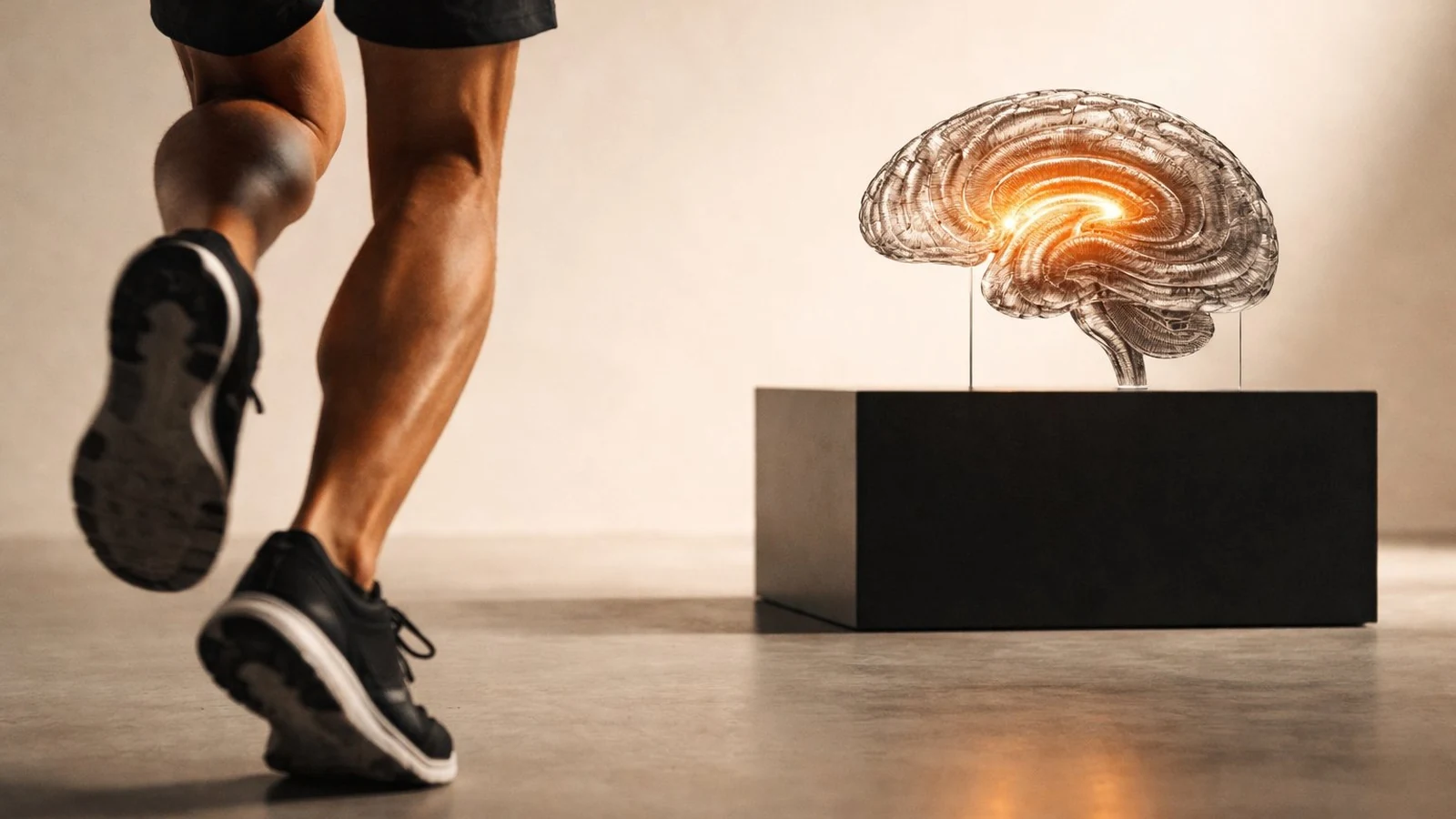
It has long been known that movement protects the brain. How exactly is still not fully understood. New research in Aging Cell provides one specific address: irisin, produced by muscles and actually reaching the hippocampus. The first human confirmation of what had previously only been shown in mice. The numbers are cautious – 74 people, cross-sectional design – but they point to very specific areas of the brain.
What is known to date: irisin as a hypothesis
Irisin is a myokine. That is, a substance produced and released into the bloodstream by skeletal muscles during contraction. Discovered in 2012 in Bruce Spiegelman's laboratory, it initially attracted attention for its ability to convert white fat into brown fat and improve insulin sensitivity.
Over time, data emerged from mice: irisin affects the brain. It increases BDNF, supports neurogenesis in the hippocampus, and reduces amyloid accumulation - meaning it acts in areas and through mechanisms relevant to Alzheimer's. However, the picture in humans remained incomplete. Some early studies even questioned the very existence of irisin in the human body - due to a peculiarity of the start codon in the human FNDC5 gene. Only after transitioning to mass spectrometry was it possible to prove that the molecule truly circulates in human blood.
What had been missing until now were data that linked three points on the same person: activity levels, irisin concentration in the blood, and hippocampal structure.
What have [they/you] done
The Thompson Institute team (University of the Sunshine Coast, Australia) recruited 74 healthy individuals, with an average age of 65 years. Each of them:
- gathered the Godin Leisure-Time Exercise Questionnaire — a standard questionnaire for physical activity over a week
- Fasted blood was taken, iris was measured
- A structural MRI of the head was performed with segmentation into hippocampal subfields - CA1, CA3, CA4, dentate gyrus and others separately.
Next is hierarchical regression and mediation analysis. The question is whether the effect of activity on hippocampal volume is mediated by irisin or direct.
Age, sex, and education were controlled.
What did you find
Three key links.
Activity → Irisin. The more a person moves, the higher the level of irisin in the blood (β = 0.365, p = 0.003).
Iridic → Hippocampus. Higher irisin – larger hippocampal volume bilaterally: right β = 0.353 (p = 0.001), left β = 0.275 (p = 0.012). Strongest effect – in specific subfields:
- right CA3: β = 0.530
- right CA4 / dentate gyrus: β = 0.471
- bilateral CA1: β = 0.336–0.373
From 22 subfield models, 9 showed significant associations — after correction for multiple comparisons.
Mediation. When irisin was added to the model, the direct effect of “activity → hippocampus volume” became non-significant. That is, practically the entire link between activity and hippocampus structure was explained by irisin.
Why is this important for CA3 and the dentate gyrus
The hippocampus is not a homogeneous structure. It is a system of subfields with specific functions.
Dentate gyrus — one of the few areas of the adult human brain where neurogenesis occurs: new neurons are born here. This process is critical for the formation of new memories and spatial navigation, and it systematically weakens with age.
CA3 — a subfield where new neurons from the DG integrate into existing neural networks. Without a healthy CA3, neurogenesis simply doesn't have a behavioural effect.
CA1 — the main “exit” of the hippocampus to the rest of the brain.
Alzheimer's begins precisely with these structures – atrophy of CA1 and neighbouring subfields precedes clinical symptoms by years. Therefore, when irisin is most strongly associated with CA3 and DG, it's not a coincidence. This means the molecule is touching the same links that break first.
Beyond the Brain: Irisin and Breast Cancer
A separate review, published in In Vivo At the beginning of 2026, it will consolidate data on irisin in the context of breast cancer. The overall conclusion of the review: physical activity reduces the risk of breast cancer partly because of irisin, which suppresses tumour cell proliferation, angiogenesis and chronic inflammation.
This does not turn irisin into a “longevity molecule”. It shows something else: one myokine can have multiple unexpected targets in different systems. The standard pattern for biology is one signalling molecule, many target tissues.
This doesn't prove it
A few points to keep in mind.
The design is cross-sectional. All measurements were made at a single point in time. Therefore, there is no causality here – only association. Possible alternative scenarios include: people with larger hippocampi train more often, or both indicators are linked to a third factor (e.g., general health).
The sample was small. 74 people is fine for a preliminary human study, but too few for confident generalisations. The effect should be tested on other cohorts and in an interventional format.
Activity was measured using a questionnaire. Self-reporting always has a bias – people tend to overestimate their activity. An objective assessment via an accelerometer would provide more accurate data.
Irysin remains a controversial molecule. Some researchers still believe its role in humans is overestimated due to methodological issues with early ELISA kits. Therefore, any conclusions about irisin should be read with a tangible degree of caution.
What should I take from this?
A specific protocol of “do X to raise irisin by Y” does not emerge from this study. It is not an RCT; training was not prescribed here, nor were dynamics measured.
What follows is another point on the map of mechanisms that explain the link between physical activity and brain protection. Not “exercise is good for the head,” but “here is one of the specific molecular addresses through which this link is realised.” Irisin is produced during muscle contraction – during both aerobic and strength training. Regular activity remains the best operational strategy, even if the exact dose for maximum irisin is still unknown.
And one more practical angle. When you again hear that “strength is for muscles, cardio is for the heart” - it's worth remembering that muscles simultaneously work as endocrine tissue. And among their output signals is one that arrives at the hippocampus.
Sources
Pace T, Levenstein JM, Quigley BL, et al. The Myokine Irisin Represents an Indirect Pathway Linking Exercise to Hippocampal Subfields Relevant to Alzheimer’s Disease and Neurogenesis. Aging Cell. 2026;25(5):e70497. DOI: 10.1111/acel.70497
Wiatr M, Partyńska A, Dzięgiel P, et al. The Role of the Myokine Irisin and Physical Activity in Breast Cancer Prevention. In Vivo. 2026. DOI: 10.21873/invivo.14284






 Українська
  English (UK)