
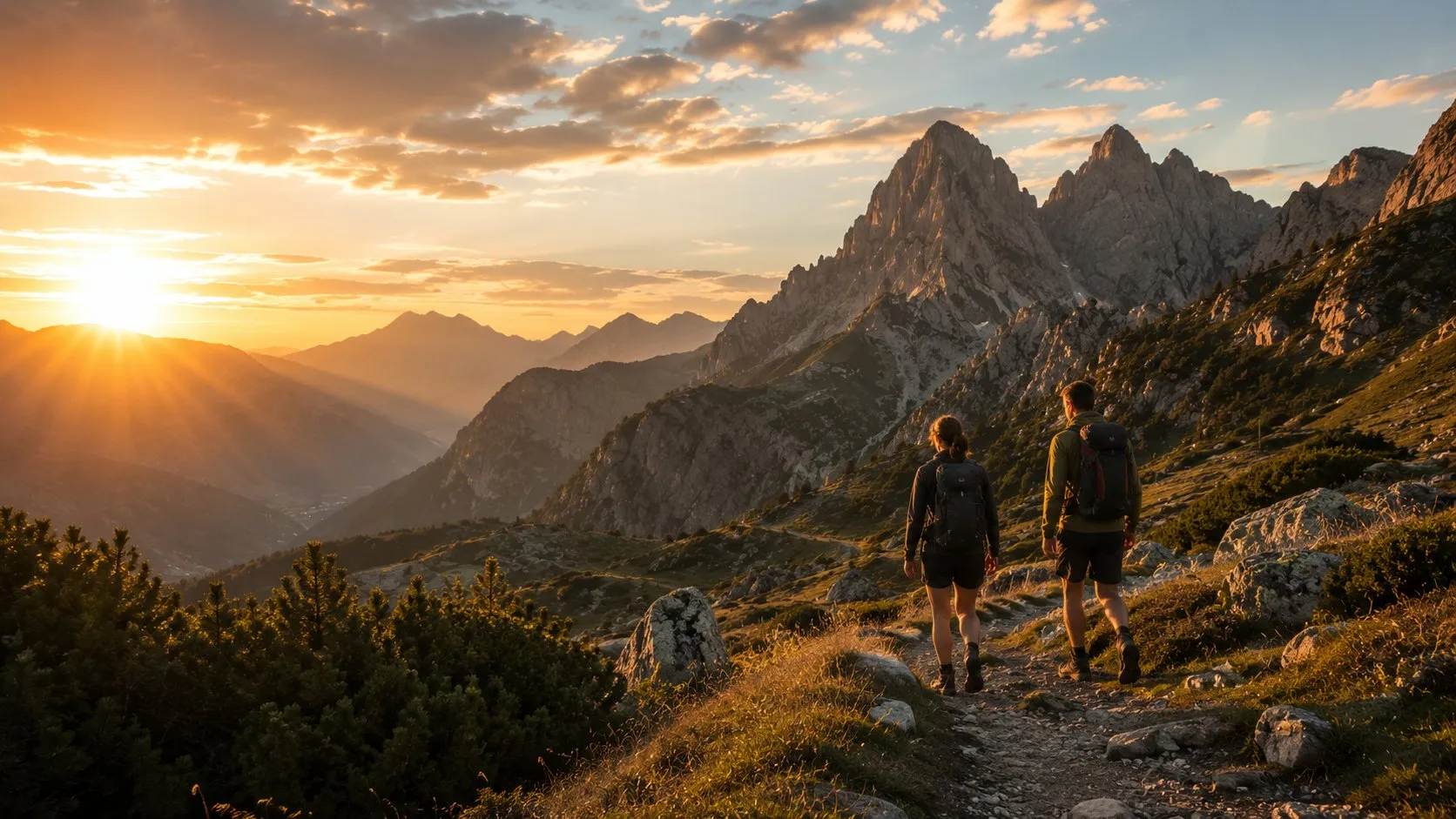
Altitude training: a week in the Carpathians vs a month in the gym.
Altitude training—or hypoxic training—is not a placebo or marketing. Air-restricting masks, which are all over Instagram, have nothing to do with altitude training. True hypoxia is another story. A new study shows: it rewrites mitochondrial gene expression within 24 hours after a single HIIT session.
What have [they/you] done
bioRxiv, Li et al., April 2026. 10 young men, well-trained, in a crossover design. Each underwent HIIT under two conditions:
- Normoxia (room air, FiO₂ = 20.91%)
- Hypoxia (FiO₂ ~13–14%, corresponding to an altitude of ~3000 m)
The protocol was repeated at two intensity levels: absolute (the same power in watts) and relative (the same % as a percentage of VO₂max). In other words, two scenarios were tested: “doing the same thing, but getting out of breath” and “doing less, but getting just as out of breath”.
Vastus lateralis biopsies – pre-training, immediately post-training, 24 hours post-training. Analysis – RNA-seq, meaning the full transcriptional response was observed.
What did you find
24 hours after hypoxic HIIT — significantly higher gene expression compared to normoxia. Especially in mitochondrial pathways regulated by HIF-1α.
Key detail: it worked on both absolute and relative intensity. Even when less mechanical work is done in hypoxia, the molecular response is still stronger. Because you simply can't produce the same power.
Genes that have grown
- HIF-1α downstream targets (VEGF, GLUT1, glycolytic enzymes)
- PGC-1α and markers of mitochondrial biogenesis
- Genes of angiogenesis (formation of new capillaries)
The body reacts to altitude training as a stronger stress signal than the same work at sea level. This is not a “feeling” – it's specific transcription in muscle tissue.
Why altitude training works: the molecular mechanism
HIF-1α (hypoxia-inducible factor 1-alpha) is a transcription factor that acts as an oxygen sensor within the cell. Under normoxia, its half-life is less than a minute. The enzyme PHD rapidly hydroxylates HIF-1α, sending it for degradation via the ubiquitin system. The body does not accumulate it.
In hypoxia, PHD loses its oxygen substrate. Hydroxylation slows down. HIF-1α is stabilised and moves into the nucleus. There it activates the transcription of dozens of genes – from those that improve glucose transport to those that build new capillaries.
HIIT itself causes temporary local hypoxia in the muscle (O₂ consumption exceeds delivery). In whole-body hypoxia, this signal is amplified – the muscle receives a “double whammy”. This leads to an enhanced molecular response – the fundamental mechanism in altitude training.
This is the biochemistry behind what coaches have known for a long time: a week in the Sierra Nevada changes the blood more than a week of similar training on the plain.
Altitude training for an amateur means
Training in the Carpathians, on Kamchatka, in the Alps – this is not a placebo. Spending 5–7 days at 2,000+ metres with moderate training sessions leads to genuine acclimatisation. Erythropoietin levels rise. Haemoglobin levels begin to increase. Mitochondrial markers increase. The classic “Live High, Train Low” approach (Levine 1997) — live at altitude, descend for high-quality training sessions. On average, a +1–21% increase in VO₂max. In endurance sports, this is significant.
Altitude tents and normobaric hypoxia also work. But they require discipline – 8+ hours a day, 3–4 weeks. This is not an investment for a winter trip.
Intermittent Hypoxic Training (IHT) — short sessions (15–60 mins) in a hypoxic environment — provide a partial effect. Works best as an add-on to a classic altitude block.
Physiological logic and the same as that in Sprint intervals for insulin sensitivity. Less work, but of higher quality, yields a greater effect than long moderate sessions. The stress signal must be sufficiently intense to trigger adaptation.
Why “height masks” aren't altitude training
To be blunt: altitude training masks (Training Mask, Phantom, and similar) are— They don't simulate altitude. This is confirmed by a good body of research – Porcari 2016, Warren 2017, Biggs 2017.
Technically: a mask restricts Flow (air flow), not FiO₂ (oxygen fraction). Atmospheric pressure and air composition through the mask are the same. At an altitude of 3000 m, the pressure is lower, the partial pressure of oxygen is lower, and this is what activates HIF-1α. The mask does not do this.
What the mask does is add resistance on inhalation. This trains respiratory muscles (diaphragmatic, intercostal), as an inspiratory muscle training (IMT) device. This may provide marginal benefit in endurance sports, but:
- In healthy individuals, the respiratory system is already “overbuilt” for most loads – it's not breathing that's the limitation, but the blood's oxygen transport and the mitochondria.
- Specialised IMT trainers (POWERbreathe, Airofit) do this job better and more safely.
- Wearing a mask in the gym instead of true hypoxia is a form of wishful thinking, not a conclusion from data.
Porcari (2016) directly showed: participants with a mask and without equally improved VO₂max. The mask only added the perception of “harder.”.
Who among these can benefit
Endurance athletes before the season — classic altitude camp scheme: 3–4 weeks at 1800–2500 m. Works best for runners, cyclists, swimmers, skiers, triathletes.
Amateurs going to the mountains for a week — combine active rest (hiking, light jogging) with a couple of quality HIIT sessions. This won't make you elite, but it provides a real micro-block of adaptation. The logic is the same as with recovery protocols after strenuous workoutsStimulus + correct processing = adaptation.
Mountain dwellers — make use of your natural advantage. You don't have to go anywhere.
Restrictions
10 men, cross-over. A small sample size is typical for mechanistic studies (biopsies are expensive and unpleasant). Transcriptional changes are gene expression, not necessarily a functional outcome. Not all genes that “light up” will produce proteins, and not all proteins will lead to adaptation. The path from gene expression to VO₂max is long and incomplete.
But the direction is clear – and it aligns with 30 years of work on altitude training. This isn't a new sensation. It's a mechanistic confirmation of what works empirically.
Conclusion
Altitude is not magic, but it is a stronger stress signal than the same work at sea level. At a molecular level, the difference is noticeable after just one day. This is true altitude training in its purest form.
Mask in the hall is not altitude. If you want altitude, you need an altitude tent or hypoxic chamber. If you don't have access to either, regular HIIT by the sea works well enough. Just don't expect it to give you the same results as the Zugspitze.
Source: Li J, Taylor DF, Kuang J, et al. Hypoxia alters the transcriptional response of skeletal muscle to high-intensity interval exercise. bioRxiv 2026. DOI: 10.64898/2026.04.22.720051
Additionally: Levine BD, Stray-Gundersen J, Living high, training low: effect on erythropoiesis, J Appl Physiol 1997; Porcari JP et al., Effect of wearing elevation training masks, J Sports Sci Med 2016.

 Українська
  English (UK)