
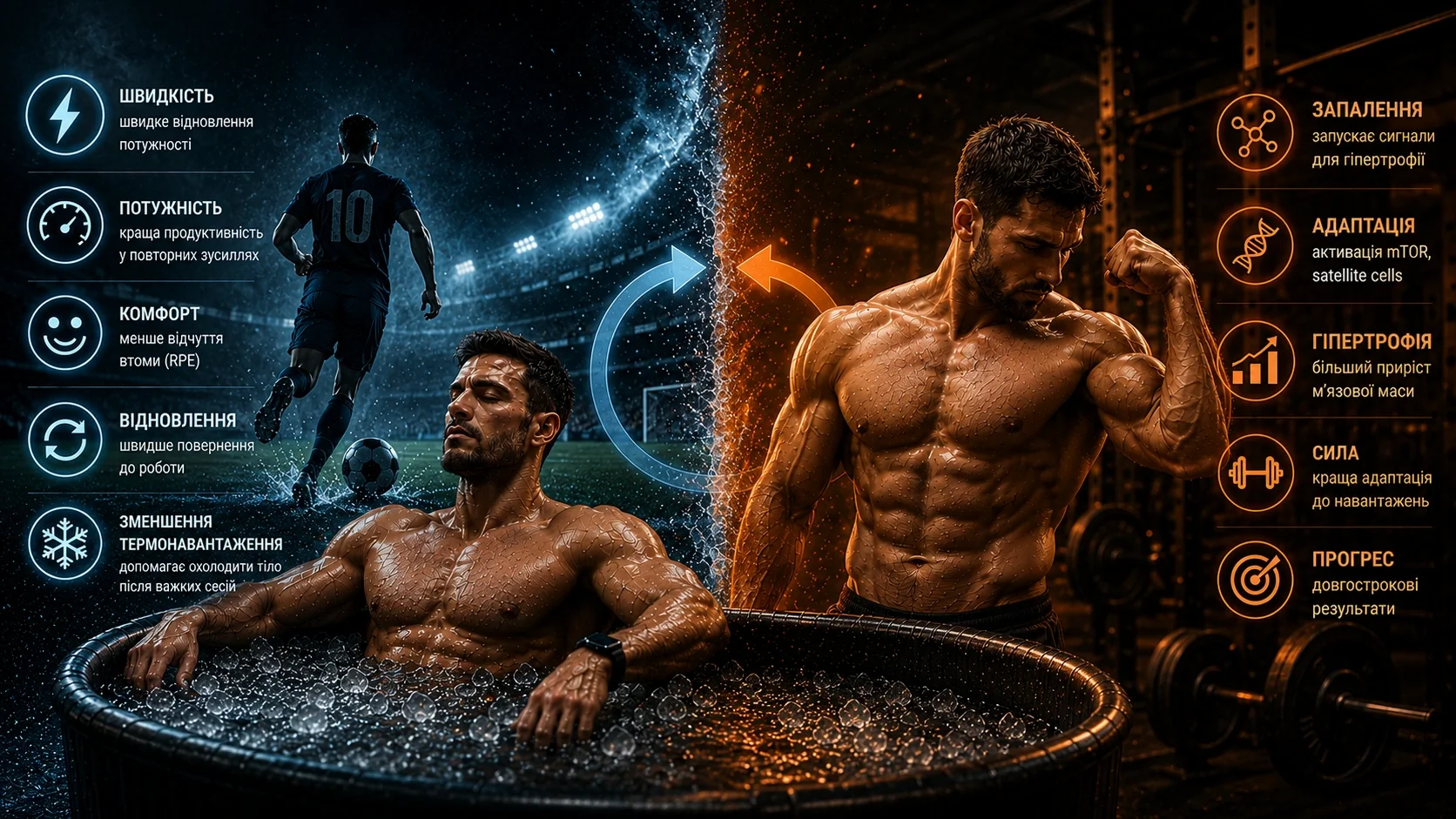
Ice bath after training: restores function, cuts hypertrophy.
A football club leaping into an ice bath after a play-off match. A bodybuilder in the off-season sidestepping it like the plague. Both are right – and fresh research explains why.
What have [they/you] done
64 physically active participants, RCT, study by Gang et al., published in PLoS ONE in April 2026. All completed a fatiguing stretch-shortening cycle (SSC) protocol – repetitive plyometric jumps that heavily loaded the lower limb musculature.
Then – randomisation into four groups:
- PCM cryotherapy at 5°C, 15 min
- PCM cryotherapy at 10°C, 15 min
- PCM cryotherapy at 15°C, 15 min
- Passive recovery (control)
PCM (phase change material) is a material with a phase transition. Unlike ice, which melts quickly at 0°C and then heats up, PCM transitions from a solid to a liquid state at a specific temperature, maintaining a stable temperature for a long time. In other words, it's controlled-temperature cold therapy, not “as cold as it gets.”.
Measurements: peak torque (PT), mean power, rate of force development (RFD), countermovement jump (CMJ), RPE, vastus lateralis and rectus femoris stiffness. Three time points: immediately after fatigue, immediately after cryo, 60 minutes after.
What did you find
Improvements
- Mean power — significantly higher in all PCM groups immediately after cryo
- Rate of force development — the same, p ≤ 0.01
- RPE — a subjective feeling of effort was lower in all PCM groups, both immediately after and after 60 minutes
- 15°C group — mean power remained elevated even after 60 minutes
It makes no difference
- Peak torque (maximum torque) – same between groups
- CMJ The jump hasn't changed
- Muscle stiffness — unaffected
- Between 5°C, 10°C, 15°C there is no statistical difference
So cryotherapy unloads function — the ability to generate force quickly, a feeling of lightness, the power of repeated movements. But Maximum strength and does not change the passive mechanical properties of the muscle.
Why are two schools right
Sports games. The footballer plays on Tuesday and Sunday. Between matches, it's important for his legs to “find” their speed, rather than coming onto the pitch with a feeling of concrete quadriceps. Cryo provides exactly that – RFD and mean power are already at a working level after an hour. This is performance recovery.
Strength and hypertrophy. The logic here is the opposite. Inflammation after strength training is not a bug, it's a feature. It triggers signalling pathways (mTOR, satellite cells) which are precisely what build muscle. Cold suppresses inflammation, which suppresses the signal, reducing hypertrophic adaptation.
This is not a theory. Roberts et al. 2015 was a 12-week RCT on resistance training individuals: one group performed cold water immersion at 10°C for 10 minutes after each session, while the other group engaged in active recovery. After 12 weeks, the cold water group experienced the 32% showed a smaller increase in muscle mass і a smaller increase in force on the 17%. Further work by Fyfe (2019) and Petersen (2024) confirmed the mechanism via signalling.
How do I use this
Cryo is appropriate when:
- Tournament day, two matches in a row
- Competitive compression sports (tennis tournament, team sports with tournament schedule)
- Tomorrow is another key session, we need to be prepared.
- Summer, a tough long session in the heat, need to quickly shed thermal load
- 24-hour recovery between intense training sessions
Cryotherapy is counterproductive when:
- Bulking phase, targeted hypertrophy
- Strength block, with the goal of pure strength adaptation
- The first 2 hours after a key strength training session (anabolic window)
- Regularly after each strength workout, it's a systematic suppression of adaptation.
Parameters from this study:
- 15 mins
- 5–15°C (it doesn't matter, choose what's convenient)
- Locally to working muscles
PCM packs are available commercially, but they can be replaced by: ice packs + a towel, a container of cold water, or immersing feet in a bath. The principle is stable contact with coolness, not extreme cold.
What does this not solve
Cryotherapy does not treat injury – it reduces pain sensation and functional fatigue. If something truly hurts a week later, ice won't help.
Cryotherapy does not replace sleep, nutrition, or appropriate training load. An athlete suffering from chronic sleep deprivation with a 1200 kcal deficit will not be saved by an ice bath.
Whole-body cryotherapy (chambers at −110°C for 3 minutes) is a separate issue, with different effects, less evidence, and a broader risk. This study did not investigate it.
Conclusion
Cryotherapy is a performance tool, not an adaptation tool. In team sports and tournament formats, the benefit is clear. In hypertrophy cycles, it's directly harmful. The worst thing is to use it without understanding which phase you are in.
The simplest rule: If you need to be fast tomorrow, cryo yes. If you need to be stronger than today tomorrow, cryo no.
Source: Gang C, Wang H, Wang Y, et al. Short-duration phase-change material cryotherapy selectively enhances early neuromuscular and perceptual recovery. PLoS ONE 2026. DOI: 10.1371/journal.pone.0347926
Additionally: Roberts LA et al., JPhysiol 2015; Fyfe JJ et al., Sports Med 2019.


 Українська
  English (UK)