
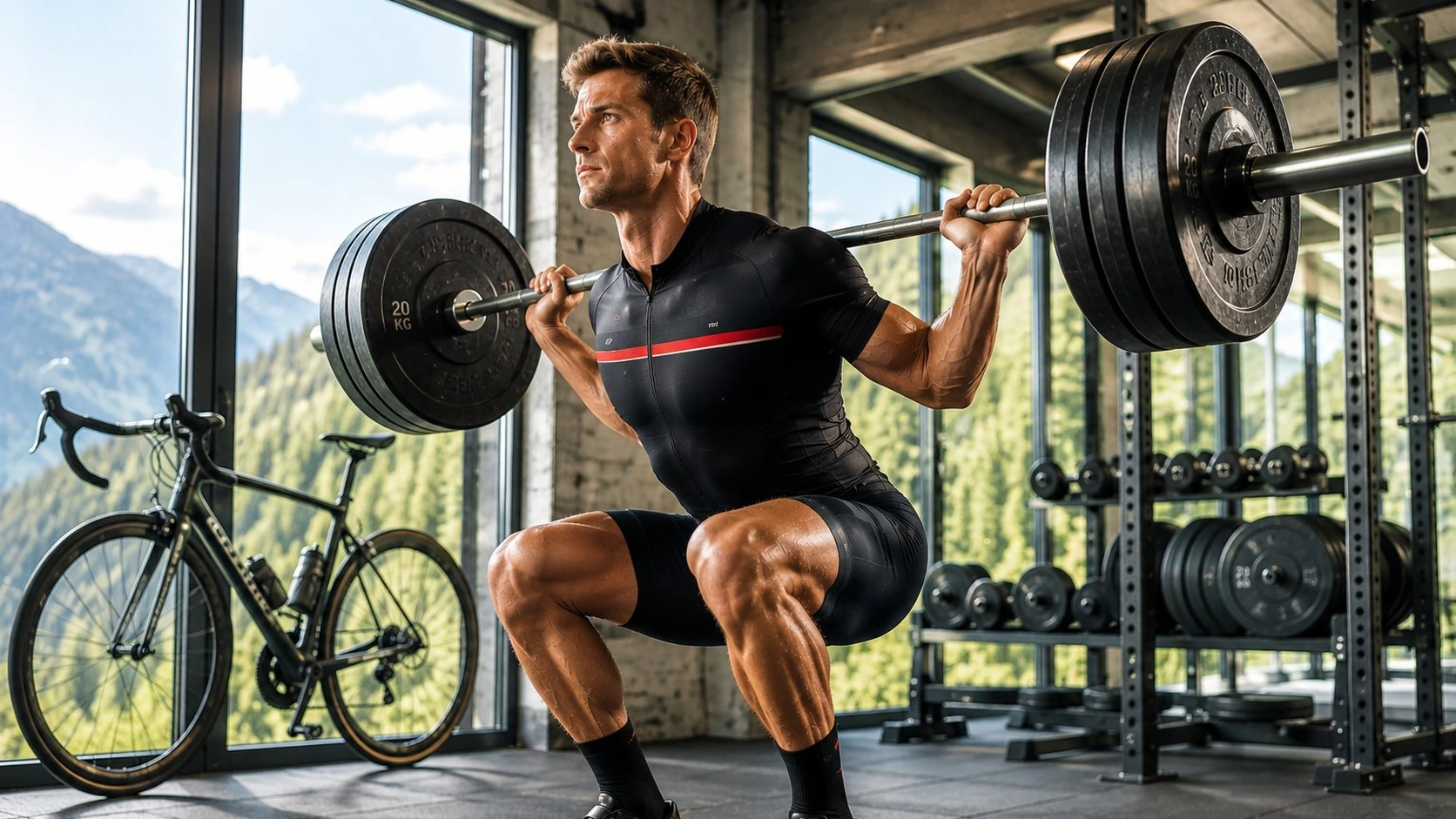
High-intensity training for cyclists: 70% max + 6% VO2max in 8 weeks.
Heavy strength training for cyclists isn’t about “gaining muscle and losing endurance”. A recent RCT in the Scandinavian Journal of Medicine & Science in Sports showed that heavy strength training at 70% of maximum capacity in trained cyclists improved anaerobic power, VO2max and quadriceps hypertrophy simultaneously. The old mantra that “strength training takes away from endurance” has not been confirmed in this context.
What did the study authors do
The Spanish team of de Pablos and colleagues recruited 36 trained cyclists – with an average of 6 years of experience and training 8-12 hours per week. They were divided into three groups:
- High-load group (HLG): strength training at 70–85% of one-rep maximum (1RM), 4–6 repetitions
- Low-load group (LLG): strength training at 30–50% of 1RM, 15–20 repetitions
- ControlOnly cycling training, no strength additions.
8 weeks. Two strength sessions per week. Cycling volume is the same across all three groups - 6-8 hours per week.
Measured: VO2max, power output during a 4-min all-out test, Wingate (30-sec anaerobic peak), vastus lateralis thickness via ultrasound, 1RM on strength-training machines.
What did heavy strength for cyclists show across all metrics
В HLG Group — significantly better results across all metrics:
- VO₂max: +5.8% — higher than in the control group (+1.2%) and in the LLG group (+3.1%)
- Power on 4-minute test: +9.4%, compared with +5.2% for LLG and +2.8% for the control group
- Wingate peak power: +12.7%, compared with +6.8% for LLG and +1.9% for the control group
- Vastus lateralis thickness: +8.3%, compared with +4.1% for LLG and +0.5% for the control group
- Squat 1RM: +24.6%, compared with +12.3% for LLG and +2.1% for control
The key thing is that the HLG group simultaneously gained both strength and endurance. This overcomes the standard “concurrent training problem” – the theory that strength and cardio in the same cycles compete for adaptation.
It turns out they only compete if strength work goes with the hypertrophy protocol (12-15 reps, moderate weight, high training volume). Heavy strength for cyclists with low reps and high weight is force-nerve stimulus, rather than metabolically catabolic. It does not compete with aerobic adaptations.
Why the 70-85% 1RM works in this particular way
Here, two modes of hypertrophy need to be distinguished.
Metabolic pathway This is a classic bodybuilding format. Many repetitions, to failure, with moderate weight. Large training volume, high lactate, pronounced mTOR signalling. It provides hypertrophy through metabolic stress. It competes with aerobic adaptations for glycogen and recovery resources.
Nerve pathway — this is pure strength. Few repetitions with heavy weight, nerves recruit more motor units simultaneously. Hypertrophy is present, but through a different mechanism — synaptic potentiation, improved muscle fibre coordination. Metabolic stress is low. It does not compete with aerobic adaptations.
For the cyclist, the second route is more advantageous:
- Provides strength and power – critical for attacks, sprints, and climbs
- Gives hypertrophy exactly where it's needed - vastus lateralis and gluteus
- It doesn't deplete glycogen - the aerobic session goes fine the next day
- Improves VO2max through better power at the same physiological values
This is not a new theory. Norwegian coaches have been working with elite runners and skiers for over 20 years using a low-volume, high-intensity strength training regime. Ronnestad et al.'s series of RCTs from the 2010s is the most well-known laboratory confirming this. This study is another confirmation in a specific population of cyclists. The principle is the same as in working with Strength training after 50 Nerve stimulus is more important than volume.
Heavy strength training for cyclists in practice
Research protocol
Session 1 (Monday):
- Back squat: 4 sets × 4–6 reps at 80–85% of 1RM
- Romanian deadlift: 3 sets of 6–8 reps at 75% 1RM
- Calf raises: 3 sets of 8–10 reps at 70% of 1RM
Session 2 (Thursday):
- Front squat: 4 sets of 4–6 reps at 75–80% of 1RM
- Hip thrusts: 3 sets of 6–8 reps at 75% of 1RM
- Single-leg press: 3 sets of 6–8 reps per leg at 70% 1RM
3-5 minutes of rest between sets. Pace – controlled eccentric (2-3 seconds down), explosive concentric (1 second up). This creates a neural stimulus, not a metabolic one.
It goes without saying that you need to know your 1RM, or at least estimate it roughly (using a 6RM test multiplied by a coefficient). Without this, “70-80%” becomes nothing more than a guess.
Heavy strength training is not suitable for cyclists who are looking to improve their explosive power and maintain a high cadence.
For cyclists during the peak season with a critical race calendar — heavy lifting 24-48 hours before a race creates DOMS, which hinders performance. This protocol is for the off-season and the basic build period (4-8 weeks from important starts).
For beginners with no strength training experience — An 80% 1RM squat without proper technique = a lower back injury. You need 6–8 weeks of building a technical foundation at 50–60% before moving on to heavier weights.
For cyclists with active lower back and knee pain — Physiotherapy first, not the gym. A heavy squat with compensatory technique due to pain will only worsen the problem.
It's the same principle of gradual progression as in Variety of training for longevity The format must reflect the current state, not ambitions.
What remains unresolved
8 weeks is a block, not a season. Whether the effect is maintained for 6-12 months, or requires support, needs longer studies. Existing literature (Beattie 2014 meta-analysis) says yes, it is maintained, but with a weekly support session.
36 participants is a normal sample size for mechanistic RCTs, not for broad generalisations. Especially regarding female cyclists - the design only included men. Female responses to heavy strength training differ and require separate studies.
Conclusion: heavy strength for cyclists — a separate tool
Heavy strength training for cyclists, using a low-rep, high-weight approach, isn’t a “muscle vs endurance” dilemma. It’s a distinct tool that works on both fronts simultaneously. Doing this twice a week during the off-season can add 8–121 TP6T of power where it’s needed most — on attacks, sprints and climbs.
This isn’t “just another standard strength programme”. It’s a specific protocol with precise parameters — 4–6 reps, 70–85% of 1RM, 3–5 minutes’ rest, controlled eccentric phase, explosive concentric phase. Without these parameters, it could just be bodybuilding, which a cyclist doesn’t need.
Sources
- de Pablos R, Valenzuela PL, Martínez-Cava A, et al. Role of pedaling intensity during strength training in well-trained cyclists: a randomised controlled trial. Scand J Med Sci Sports. 2026. DOI: 10.1111/sms.70294
- Ronnestad BR, Mujika I. Optimising strength training for running and cycling endurance performance: A review. Scand J Med Sci Sports. 2014;24(4):603-612. DOI: 10.1111/sms.12104






 Українська
  English (UK)