
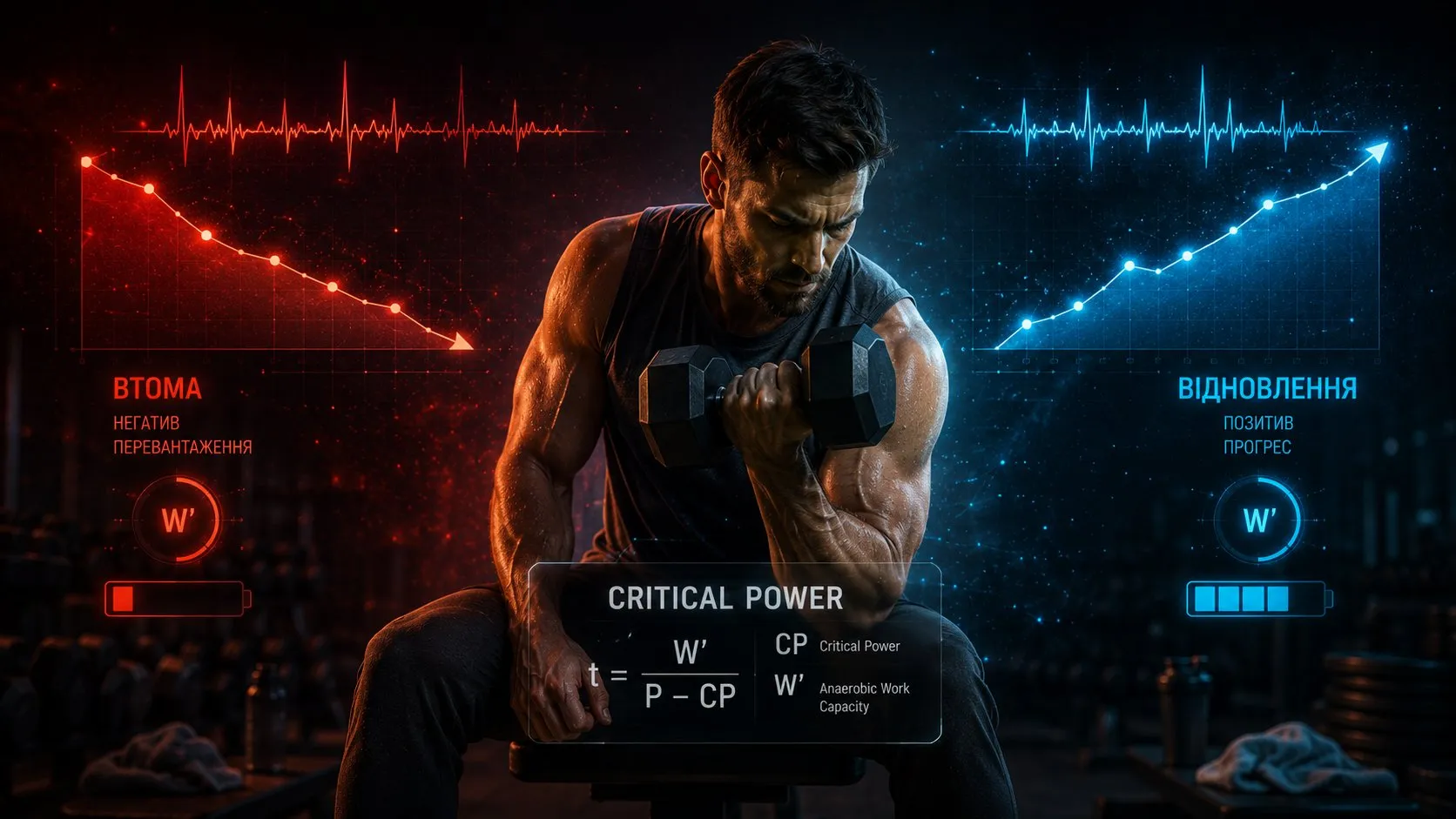
Critical power for strengths: 8 second error vs 19.
Critical power is the physiological power output that can be sustained for a prolonged period without transitioning into an unsustainable state. Since the 1960s, critical power has been applied to cycling and running. Recent research by Wu et al. (J Biomed Eng 2026) has adapted the model for resistance exercise and demonstrated: an improved version predicts time to failure with an error of 8 seconds compared to 19 seconds for the baseline model. This is the difference between “approximately” and “practically useful.”.
What have [they/you] done
Researchers at the Chinese Centre for Biomedical Engineering have taken the classic critical power (CP) model, which has been used for cycling and running since the 1960s. They have adapted it for dynamic strength exercises Dumbbell curls.
The classic CP model has two parameters:
- CP — power that can be sustained “indefinitely” (theoretically). In practice - 30-60 minutes.
- Which’ (“W prime”) — the final amount of work that can be done Above CP. Looks like an anaerobic reserve “battery”.
The logic is simple. If you output 110% CP, you consume W’ proportionally. When W’ = 0, depletion sets in. Example: CP = 200 W, W’ = 20 kJ. You’re running at 240 W (+40 W above CP). W’ will run out in 20,000 / 40 = 500 seconds.
Wu and colleagues improved this model for the strength context and tested it on dumbbell biceps curls.
What did you find
Accuracy of predicting exercise duration (time to failure):
- Critical power base model: mean error 19.79 seconds
- Improved model: mean error 8.01 seconds
Translation: if you’re doing 10 kg curls to failure, and failure occurs after ~60 seconds — the old model is off by 33%, the new one by 13%. That’s the difference between “roughly” and “practically useful”.
This Mathematical Improvements. Not new physiology, not a new formula. More precise processing of the same data, taking into account the dynamics of fatigue in strength exercises.
“To refusal” is not precise
On Instagram, “to the point of exhaustion” sounds like a single, clear benchmark. In physiological reality, this concept conflates several phenomena.
Technical failure. The last rep with compromised form. It is not true muscular failure – it is neuromuscular. The CNS lowers drive to avoid injury.
Concentric rejection. You can't lift the barbell from the bottom position. The muscle can still hold, but it cannot shorten. This is a classic “to failure” in strength training.
Isometric disclaimer. You cannot hold the position. This is already a deeper point.
Complete exhaustion. You can't move at all. Healthy people hardly get there because the CNS stops them earlier.
“To failure” in different people, settings and exercises can mean different of these points. Hence the noise: one study says “to failure 8 repetitions”, another - 14. This is not a contradiction. This is a vague definition.
Critical power gives an objective physiological point: not “sense of effort”, but a specific relationship between work power and CP. This is a better metric.
Critical power is important for amateurs because it represents the highest sustainable power output an athlete can maintain for an extended period. Understanding and training to improve critical power allows amateurs to: * **Improve endurance:** By increasing critical power, athletes can sustain higher efforts for longer, making them more competitive in events and improving their overall stamina. * **Pace effectively:** Knowing your critical power helps in setting realistic and achievable pacing strategies for races and training rides, preventing premature fatigue. * **Optimise training:** Critical power is a key metric for designing training zones. Training near or above your critical power can be highly effective for improving fitness efficiently. * **Track progress:** As an amateur's fitness improves, their critical power will increase, providing a quantifiable measure of their progress over time. * **Enhance performance in various disciplines:** Whether it's cycling, running, or triathlon, a higher critical power generally translates to better performance.
Volume dosing without overreaching. If you know your CP and W’ for a particular exercise, you can plan accurately. For example: “Today I’ll use 60% W’ in my workout; I’ll need to recover by tomorrow.” This is the basic logic behind programmed training. In elite sport, it’s standard practice. In the gym, it’s a rarity.
Understanding between-set fatigue. W’ does not recover instantly. A standard 1–2-minute rest period results in partial recovery of W’ (approximately 50–70%, depending on the individual). A 3–5-minute rest period results in near-complete recovery. This explains why, in strength training with short rest periods, the number of repetitions drops rapidly. You simply haven’t fully recovered your W’.
Why RIR/RPE are proxies. RIR (reps in reserve) is a subjective assessment of how many repetitions are left before failure. RPE is a related scale of effort. Both are popular because they are easy to apply. But both are approximations of what critical power provides objectively. A trained person assesses RIR with an error of ~1-2 reps. CP/W’ does this without subjectivity when data is available.
This is the very shift from the subjective to the objective that occurs with all training metrics — from the feeling of “running at 80%” to the specific watts on the power meter. In Sprint intervals for insulin sensitivity This allows us to track the minimum effective work. Critical power does the same for strength — it sets the upper limit.
Why doesn't this mean “train with the lab”?”
Measure CP/W’ for a specific exercise Not just. The classic method is a series of “maximal effort to exhaustion” tests with different loads. Then, regression using the hyperbolic power-duration curve. For an amateur, this is unrealistic.
What works as a practical compromise:
- RIR-based programming. Leave 1–2 reps in reserve on most sets. This roughly equates to working slightly above CP. Sustainable, with progression, without a breaking point.
- One approach to the end of the line. If you want to assess “where you are now” – one or two sets to concentric failure at the end of a workout. Not every set. Not every day.
- Cycling and running - critical power is easy. If you train with a power meter on your bike, FTP (functional threshold power) tests are a practical approximation of CP. Many programmes use this.
- Running apps (Stryd, COROS, Garmin) calculate running CP automatically from training data. This is not complete laboratory accuracy. But it is sufficient for practice.
What's new does critical power add to the power model
The work by Wu et al. did not “find a new molecule”. It Methodological improvement, which shifts strength exercises from the “not modelled” category to the “acceptably modelled” category. In 5–10 years, this could become the basis for:
- Smart strength training machines that know your W’ and automatically stop your set at the right moment
- Wearable sensors that calculate critical power from real training data
- Algorithms for an adaptive programme that changes from training session to training session
Currently, it's a tool for biomechanics and researchers. In a few years, it could be in every gym.
Restrictions
Dumbbell curls are a simple isolation exercise. Complex compound movements (squats, deadlifts) have a different dynamic. The model may require further adaptation.
Individual variation is huge. CP and W’ depend on muscle fibre type, training status, and genetics. “Average error of 8 secs” is the group average. For a specific individual, it can be larger.
This is bench-scale work. Until wearable sensors emerge that can calculate CP/W’ from ordinary training data, for an amateur it remains conceptual information. Not a practical tool.
Conclusion
“Until failure” is not a scientific metric. It's a vernacular one. Physiology provides objective points. Critical power divides steady and unsteady states. W’ divides the reserve into specific kilojoules. The more accurate the models, the more precisely one can train without excessive fatigue and without insufficient stimulus.
For most people, RIR/RPE is currently an accessible practical tool. But the direction is clear. Objective dosing will also come to the amateur gym. It's a matter of technology and time.
Source: Wu X, Shang J, Niu X, et al. Quantitative assessment of muscle fatigue based on improved critical power model. Journal of Biomedical Engineering 2026. DOI: 10.7507/1001-5515.202510061
Additionally: Monod H, Scherrer J, Ergonomics 1965 (original CP model); Jones AM et al., Critical power: implications for determination of VO2max and exercise tolerance, Med Sci Sports Exerc 2010.





 Українська
  English (UK)