
Sprinting versus time trials: what's better for insulin sensitivity
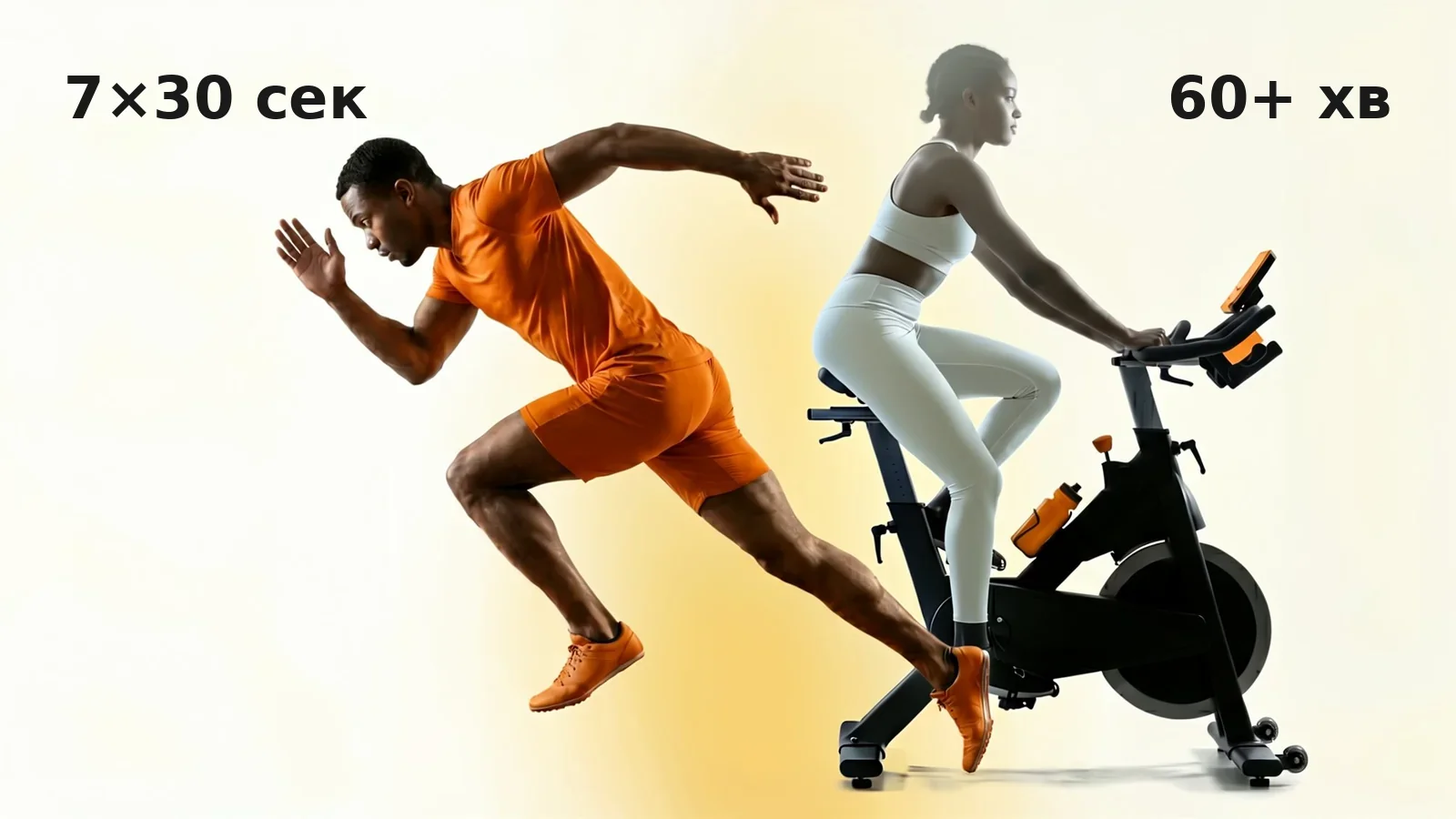
A recent RCT in the American Journal of Physiology compared a single session of sprint interval training (7 x 30-second sprints) with 60 minutes of moderate pedalling – and the sprint format, despite 6 times less work, resulted in a greater and longer-lasting increase in insulin sensitivity. I'm breaking down what this means in practice.
Insulin sensitivity – and why it’s a critical metric
Insulin sensitivity is how well the body «lets in» glucose from the blood in response to an insulin signal. When it's low, the pancreas pumps out more insulin. When there's chronically too much insulin, this is the starting point for pre-diabetes, metabolic syndrome, and cardiovascular risk.
Muscles are the main consumer in this process: around 80% of postprandial glucose in a healthy person is directed there. Exercise is the primary means of keeping this system sensitive. The question remains: which specific form of exercise is best – and how quickly does it start to work?.
What have [they/you] done
A team from the University of Galway, Inserm Toulouse, Dublin City University and several other centres launched a randomised cross-over design with 12 healthy young recreationally active men. Each underwent three conditions on separate days:
- SIE (sprint interval exercise) 7 sets of 30-second all-out sprints at 130% power, totalling a 35-minute session including warm-up and recovery
- MICE (moderate-intensity continuous exercise): 65% power cycling for 60 minutes
- Against control, without exercise
Insulin sensitivity measured via Hyperinsulinaemic euglycaemic clamp. This is not a blood glucose meter or a simulated OGTT – it's the gold standard of physiology. Insulin is infused at a fixed rate, glucose is infused in parallel to keep its level stable, and we see how much needs to be infused. More is needed – higher sensitivity.
Additionally, pre- and post-exercise muscle biopsies with quantification of glycogen stores and phosphorylation of signalling proteins (glycogen synthase, GSK-3β, Akt).
What did you find
Three numbers worth remembering.
6 times less mechanical work in SIE. A sprint session of general work is six times less than an hour of moderate pedalling. Not a small difference, but an order of magnitude.
2. Greater and longer-lasting insulin sensitivity gain in SIE. And by the overall system metric (via clamp), and at the muscle level. Not «the same as MICE», but specifically greater. And it lasted longer.
3. The muscles behaved like a sponge. After SIE, there was more glycogen depletion during the session and more regeneration during the clamp. Phosphorylation of glycogen synthase and GSK-3β decreased; Akt did not change. This means the pathway to increased sensitivity was not via the standard Akt cascade, but through other links.
What does this mean in practice
Intensity is a distinct variable, not simply «concentration for 35 minutes».
The usual assumption that «more time equals more adaptation» didn't hold true in this experiment. Short supramaximal stress triggered responses that an hour of moderate load elicited more weakly, despite a significantly greater volume of work.
For someone with limited time, this is a specific argument against regarding sprint format as a last resort for athletes. Seven 30-second efforts equate to 3.5 minutes of pure maximal effort. The remaining 30+ minutes of the session are spent warming up, resting between reps, and cooling down.
What does this NOT mean
This is where the important bit begins.
This isn't «throw away your cardio hours». MICE also provided a boost in sensitivity – just less and shorter-lasting. The hours at a moderate intensity offer other benefits that SIT doesn't provide: the volume of mitochondrial work, aerobic base, and low-stress stimulus. The two systems complement each other, rather than competing for a single slot in the week.
This is an acute effect, not a chronic adaptation. The study looked at what happens afterwards one sessions. How acute reactions accumulate into a long-term training effect is a separate question, which overlaps with other RCTs (there, SIT also holds up well, but be careful with generalisation).
These are 12 young, healthy men. Not women, not people with pre-diabetes, not those over 60. It is possible to cautiously predict that the trend will continue, but the exact figures in other populations will differ.
SIT is not safe for everyone. Maximum exertion significantly raises blood pressure and heart rate. Untreated hypertension, arrhythmia, active cardiovascular pathology – SIT only after consultation with a cardiologist. And never without a warm-up.
What remains
The blog has already featured posts about Exercise snacks (short bursts of exercise instead of an hour in the gym) and about variety of training. This study extends the same line of thought from another angle: intensity is a separate coordinate axis, not just an «added bonus» to duration. In conjunction with format diversity, this provides a tool that can be incorporated even into a busy day.
And this is precisely why the platform gathers it all in one place. One RCT with a glucose clamp is a different weight of evidence than the advice of an Instagram trainer. An intelligent person who can use their brain will see the difference – the only question is whether they have somewhere to keep this data alongside their own statistics.
Source
Murphy E, Laurens C, Frances L, et al. Acute metabolic and molecular responses to sprint interval versus moderate-intensity continuous exercise in healthy young men. American Journal of Physiology - Endocrinology and Metabolism. 2026 May 1;330(5):E562-E571. DOI: 10.1152/ajpendo.00548.2025
Vitaliy
Founder of life:)on





 Українська
  English (UK)