Not easier, but longer: +20% of stamina from your own playlist
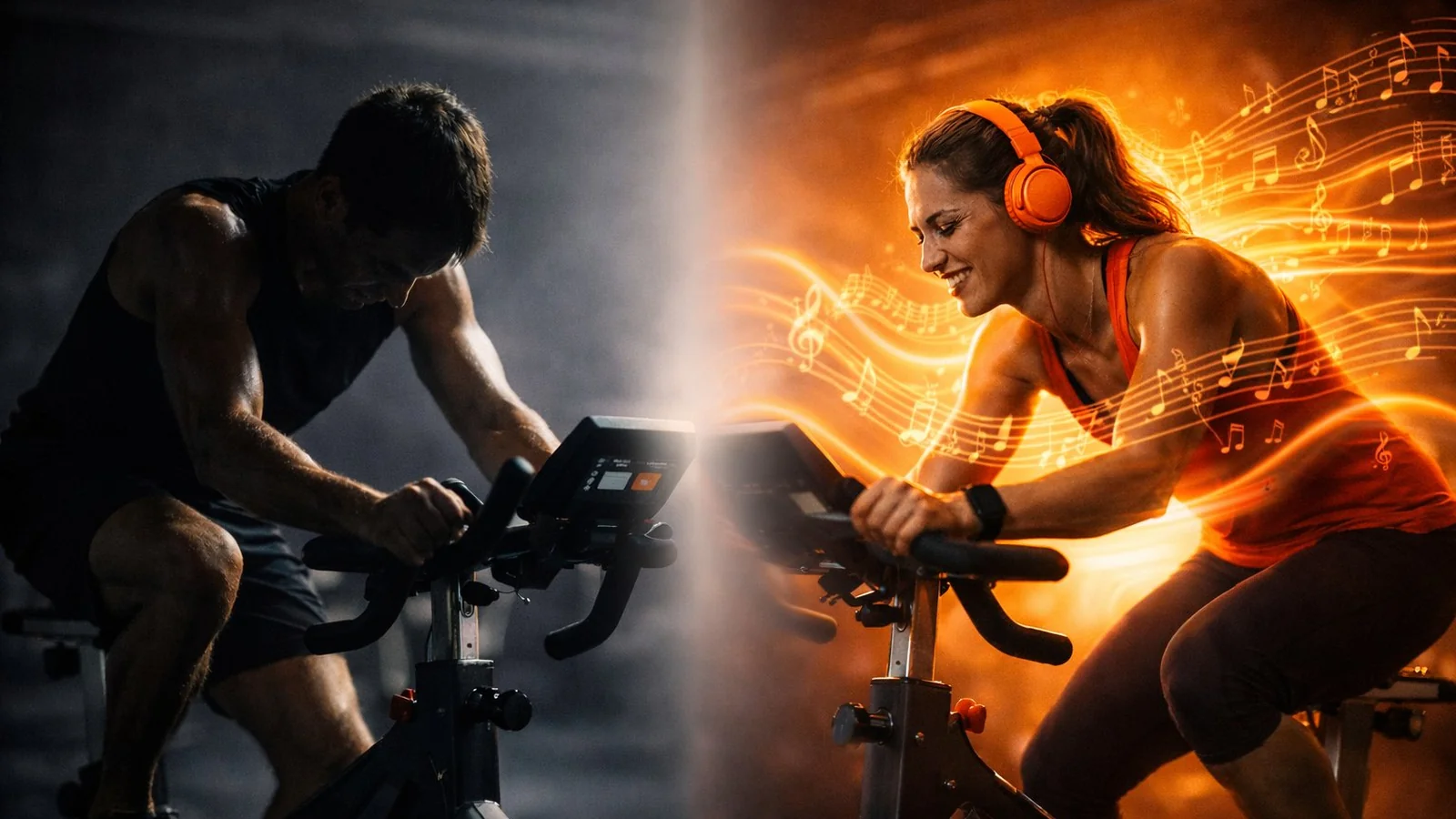
A simple experiment. Two exercise bike sessions with the same workload. One in silence, the other with my own playlist. The time to exhaustion increases by 20%. The heart is working the same, lactate levels are the same, and the sensation of effort is the same. The body lasts longer with the same physiological indicators.
Research from the University of Jyväskylä has appeared in Sport and Exercise Psychology 9 May 2026. Music and training have been written about for a long time. What's interesting is: data shows Where exactly works and What exactly makes it stable.
What have [they/you] done
29 physically active adults. Two tests on a cycle ergometer at the same intensity — 801% of peak power. In other words, it’s tough: heart rates are through the roof, and it’s hard to talk. One test was carried out in silence. The second was carried out with music chosen by the participants themselves.
Keyword They chose themselves. Not «experimenters switched on a motivational montage». Not «standardised playlist of 130 BPM». The participant came with their own song list. Most tracks fell within the 120-140 BPM range – but that’s a consequence, not a requirement.
What did you find
- With your own playlist: 35.6 minutes to exhaustion
- In silence 29.8 minutes
- Difference ~20%, or an average of 6 extra minutes
And most importantly — The fatigue indicators at the end are the same. However, the pulse is the same. Blood lactate levels are the same. The Rate of Perceived Exertion (RPE) is also the same.
So music doesn't reduce physiological tension. It's not «getting easier.» It's «not getting harder for longer.» At first glance, it's the same thing – but actually, it's not.
Why isn't it «getting any easier»?»
Andrew Danso, the lead author of the study, formulates the effect through the term pain zone tolerance — tolerance to the comfort zone. High-intensity training involves increasing pain and discomfort. At a certain point, the brain says «enough». With your own music, this point is pushed back. No side effects. No physiological changes.
This is fundamentally different from:
- Caffeine which alters the perception of effort through the CNS, but has side effects and tolerance
- Standard «motivational» playlist — it might work too, but the data is more persistent about Please provide the rest of the sentence or any context you can for a more accurate translation. The phrase "саме про" is incomplete. self-selected
- Encouragements from others - short-term and exhausting
Analogy: it doesn't become easier to carry a heavy suitcase. You simply allow yourself to carry it for longer.
Why self-selection is not a vacant condition
Researchers emphasise independent choice. Why this may be important:
- Emotional attachment — songs that are associated with specific moments or states work differently than neutral music
- Familiarity — the brain doesn't expend attention on new audio input because it knows what's coming next
- Autonomy — what a person chooses for themselves is perceived differently than what someone else chooses
These are hypotheses—specifically, this study did not break down the mechanisms. But the data are stable: 29 people, statistical significance, a replicated design.
Where can this be moved to (and where not)?
The research was conducted on a cycle ergometer at high intensity. Directly applying it to everything is incorrect. What obvious from the data:
- Designed for sustained high-intensity operation (~80% peak power)
- It works when the athlete chooses the music themselves.
- It doesn't give a win in power or physiology - only in time under load
What It's logical to assume, but not proven with this research:
- A similar effect when running at high intensity
- A similar effect for strength athletes - especially in «to failure» sets.»
- A similar effect on long, low-intensity sessions (Z2 cardio, long walks).
[insert personal detail – your experience with music during workouts / weightlifting / running]
There is a 2021 paper about running with music under mental fatigue – it also had self-selection and improvements. There are few systematic reviews so far.
Scope of research
29 participants is too few for serious generalisations. Cross-sectional design (one group, two tests). The intensity is high – it is unknown if the results would change at a low intensity. Gender was not analysed separately. Genres and tempo of music were not broken down as separate factors. Authorship: University of Jyväskylä in collaboration with the Finnish Institute of High Performance Sport and Springfield College, meaning financially independent of the music industry.
This is a signal, not a verdict. The study should be read as confirmation of a previously known effect with specific figures, rather than as a new «hack».
Summary
Having your own music during an intense workout is a zero-cost tool that allows you to endure the load for longer. With no side effects. Without altering the physiological strain. Without reducing effort.
Time under load is the currency of adaptation. More quality time equals better adaptation. Your own playlist buys this time for zero hryvnias and zero milligrams of anything.
Source: Danso A., Hutchinson J.C., Laatikainen-Raussi V., De Lucia B.J., Vänttinen T., Long K., Burbidge E., Walker S., Ihalainen J.K., Luck G. Feel the beat, not the burn: the effects of self-selected music on time-to-exhaustion cycling. Psychology of Sport and Exercise, 2026; 85: 103116. DOI: 10.1016/j.psychsport.2026.103116


 Українська
  English (UK)