
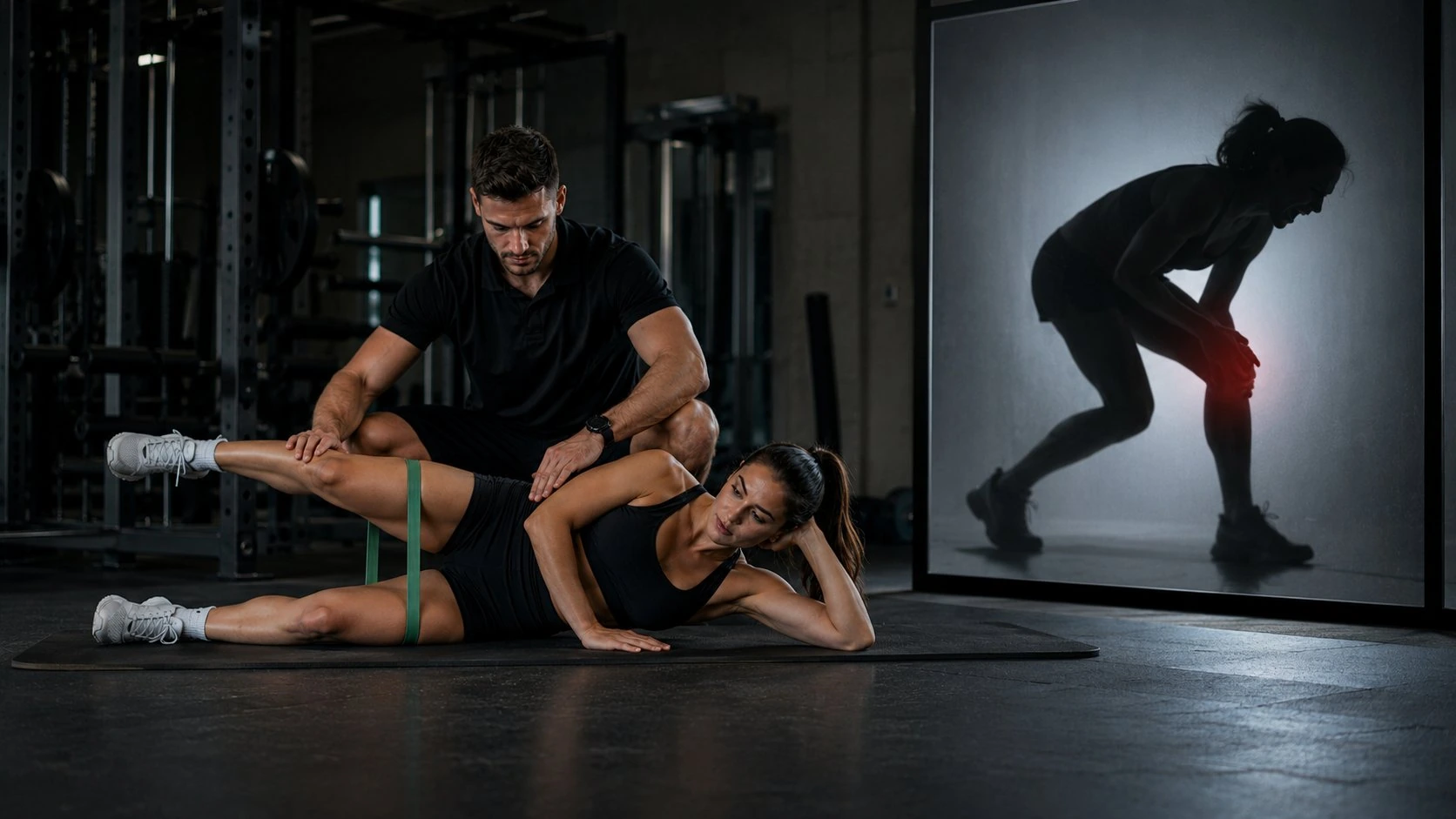
Eccentric hip abductor training: one exercise against the #1 factor in knee injuries
Eccentric hip abductor training is not a new discipline, but rather an old exercise translated into a different mode. A fresh pilot study in PLoS One showed that four weeks of the eccentric variant reduced dynamic knee valgus in young women more strongly than the classic concentric version. Dynamic valgus, of course, is that inward-collapsing mechanism behind ACL injuries, patellofemoral pain, and ITB syndrome.
What did the study authors do
The Hungarian team (Fésüs et al.) recruited 30 healthy young women, who were recreationally active. They were divided into two groups: one performed eccentric hip abduction for 4 weeks, and the other performed concentric hip abduction. The volume and frequency were the same for both groups. Before and after the intervention, dynamic knee valgus was assessed during a single-leg squat and a drop jump using 3D motion capture.
Dynamic valgus is when the knee “collapses” inwards during a squat or landing. The foot turns out, the knee turns in. It looks like the letter X. This is not a postural defect, but a functional deviation at the moment of load, due to weak hip stabilisers.
Why do eccentric hip abductors work better
In the eccentric group, a significant reduction in the valgus angle. In the concentric group, there is also a reduction, but less pronounced and not sufficient to be statistically significant.
Why the eccentric hip abductor works better. Dynamic valgus occurs during the braking phase – when the foot touches the ground, the knee bends, and body mass presses down. At this moment, the hip abductors (gluteus medius, minimus) must prevent the hip from rotating inwards – and this is eccentric work. Training them concentrically means training a movement that won't happen in a real situation. Eccentrically means training the exact pattern that stabilises the knee.
The logic here is specifically training-related. The SAID (Specific Adaptation to Imposed Demands) principle states: the body adapts precisely to the mode in which you train it. Concentric leg raises train Lift Legs. Eccentric lowering trains Braking Descent. On the field, when an athlete lands, braking is required, not lifting.
Why is this relevant not only for women
The original design featured women because they more commonly experience dynamic valgus due to a wider pelvis and a different Q-angle. However, the mechanism is universal. A male runner over 40 with patellofemoral pain, a powerlifter whose knees cave inwards under heavy weight, or a basketball player with recurrent ACL injuries – these all represent the same pattern, the same weak gluteus medius in the eccentric phase.
ACL injuries in recreational sport — 70% are non-contact. In other words, they are not caused by a collision with an opponent, but by the player’s own movement upon landing. Reducing knee valgus reduces this risk before reconstruction and 9–12 months of rehabilitation become necessary.
ACL reconstruction in Ukraine at a private clinic costs 50-80 thousand hryvnias, plus a year of physiotherapy. In Europe, it's €5-15 thousand. Ten minutes on a mat three times a week is the cheapest insurance possible. This is the same principle as Variety of training for longevity — a small regular contribution with a big long-term effect.
Here's what the eccentric hip abductor exercise looks like
Classic side-lying hip abduction, but with a modification for eccentric mode.
Lying on your side, bottom leg bent, top leg straight. A partner or resistance band/weight pulls the top leg downwards towards the floor. The task is to slowly lower the leg against this resistance for 4-6 seconds. Then, the partner helps lift the leg back up (quickly, this phase is not the focus), and slowly lower it again.
3 sets of 8-10 repetitions for each leg. 2-3 times per week. Don't overdo it, no weight to start with – technique and pace are the priority. If you don't have a partner, a resistance band attached to a low anchor point provides the same effect.
Alternative exercises in a similar mode: eccentric side-step with an expanded band (lateral step with a slow return), Copenhagen plank with an emphasis on a slow lowering phase for the adductors as antagonists, single-leg eccentric squat with a focus on 3-4 seconds down.
How to check if you have dynamic hallux valgus
The simplest home test is a single-leg squat in front of a mirror. Stand on one leg, slowly squat to 45-60 degrees at the knee, and return to standing. Look forwards.
Red flags:
- The knee moves inwards relative to the foot (not onto the foot, not behind the foot – but towards the other leg)
- Trendelenburg sign
- The foot broke and fell inwards.
If even one of these applies, you have weak hip stabilisers, and valgus will occur during any dynamic movement: landing, sprinting, or heavy squatting. Eccentric hip abductor – a direct target for this compensatory pattern.
Where else does a weak gluteus medius pull
A separate layer of the problem. When the hip abductors are weak, the body seeks compensation. Most often, the iliopsoas muscle and the TFL (tensor fasciae latae) become involved. The result is a tightened ITB, pain on the side of the knee when running, and lower back pain from chronic overloading.
So, knee valgus is not a local knee problem. It's a symptom of a systemic imbalance in the foot-knee-pelvis chain. The eccentric hip abductor works precisely where the chain breaks – it strengthens the very muscle that's meant to keep the pelvis stable. This is the same principle as in the approach to Strength training after 50 — train not “general fitness”, but specific weak links.
What does an eccentric hip abductor not solve
This is not a panacea for all knee injuries. If there is already pain, see an orthopaedist or physiotherapist first. If there are problems with the meniscus, chondromalacia, or a previous ACL surgery, the exercise can be added, but as part of a programme, not as a replacement.
It does not work for foot problems (flat feet, weight transfer to the inner arch) – these problems need to be treated separately, through insoles and exercises for the inner foot muscles. It does not correct cartilage changes that have already occurred.
The study is a pilot study, with 30 participants, over 4 weeks. It's not “proven for all populations.” It's a strong signal in the right direction, which aligns well with 20+ years of lower limb biomechanics work. Larger studies are still to come – but the direction of the effect is clear.
Conclusion: one exercise with a specific mode
The cheapest and most obvious prevention for knee injuries is 10 minutes three times a week, lying on a mat, with a slow lowering of the leg against resistance. No equipment, no gym, no trainer. And it's the eccentric mode that makes the difference – concentric gives half the effect.
This is a rare instance where science provides a simple answer: one eccentric hip abductor exercise, a specific regimen, a specific outcome on a specific risk factor. A small investment with a large safety margin for years.
Sources
Hewett TE, Myer GD, Ford KR. Anterior cruciate ligament injuries in female athletes: Part 1, mechanisms and risk factors. Am J Sports Med. 2006;34(2):299-311. DOI: 10.1177/0363546505284183
Fésüs Á, Sebesi B, Murlasits Z, et al. The effects of 4-week eccentric versus concentric hip abductor training on dynamic knee valgus in young women: a pilot study. PLoS One. 2026. DOI: This DOI refers to a publication. It does not contain any text to translate.






 Українська
  English (UK)