
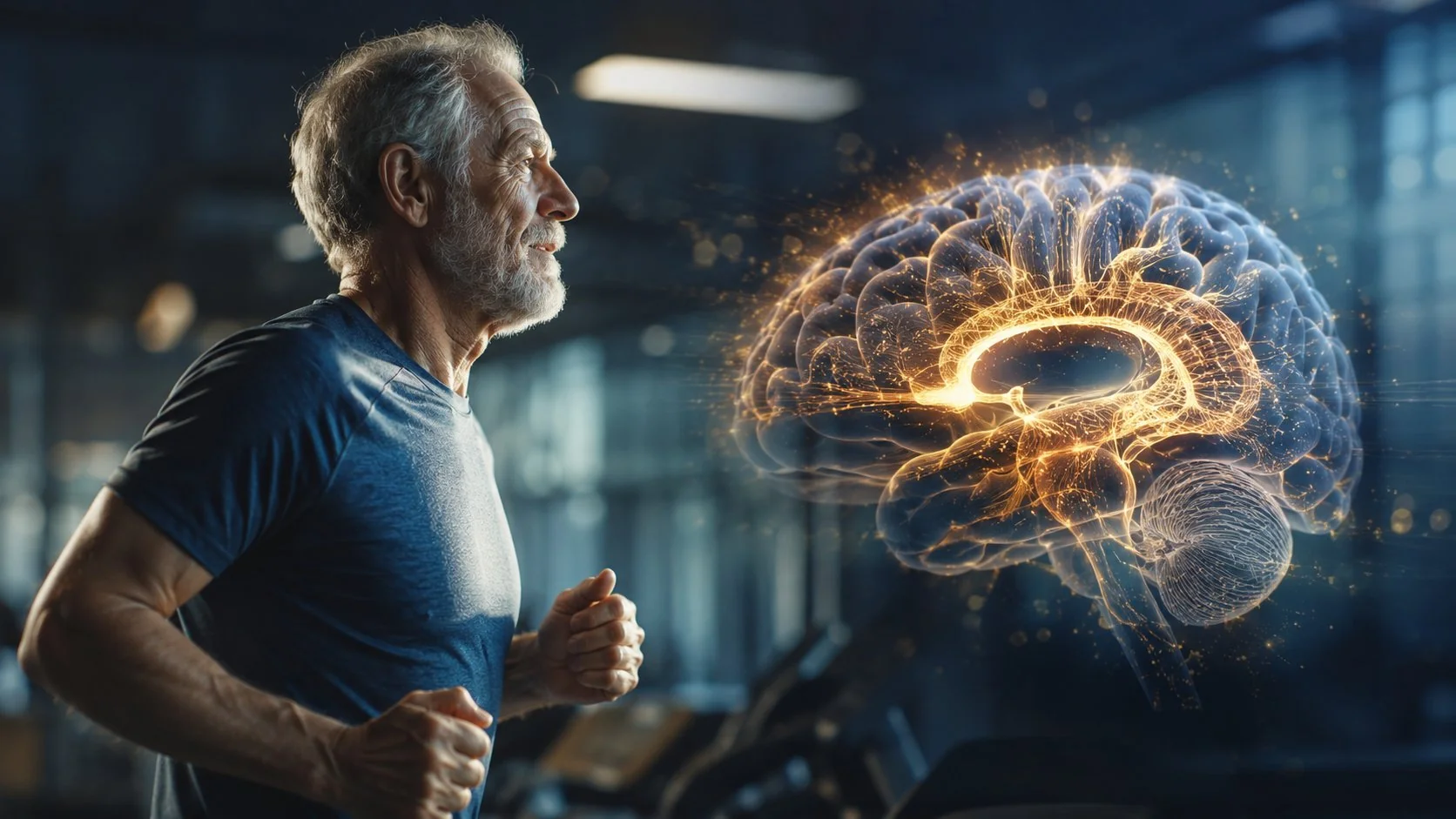
White matter: Why physical activity rewrites the brain after 50.
White matter — the brain's white matter — is not a passive cable between neurons. It is a tissue that movement can rebuild, even in old age. A new longitudinal study from May 2026 tracked 715 adults. It showed a simple, yet counterintuitive thing: the brain doesn't just degrade with age, it reorganises itself. And physical activity drives this rebuilding. It sounds like an Instagram slogan. But this time, behind it is diffusion MRI and 52 specific neural tracts, not general words about the benefits of sport.
What is white matter and why does it age first
Grey matter is the cell bodies of neurons, where computation takes place. White matter is the myelinated axons that connect these computational centres. If grey matter is the processors, then white matter is the cabling network of a data centre. Without a functioning network, even powerful processors are idle.
As we age, this network deteriorates. Myelin degrades, axons lose conductivity, and signals between brain regions slow down. This is precisely why physiologists primarily link age-related reaction time slowing to the state of white matter. The same applies to the decline in so-called fluid intelligence – the ability to solve new, unfamiliar problems without relying on learned knowledge.
Why should movement in general reach the brain's cable network, and not just the muscles? The mechanism has long been described in animal models. Aerobic exercise raises levels of brain-derived neurotrophic factors, improves blood supply to nerve tissue and stimulates myelin sheath cells. In other words, movement creates a favourable biochemical environment. In it, white matter has the resources for repair and rebuilding, not just wear and tear.
The classic picture was one of pessimism. The network degrades, conductivity falls, and this is irreversible. Research in recent years has shattered this picture – and physical activity has played a key role in shattering it.
Research 2026: The brain doesn't shut down, it rebuilds
Josh Neudorfer analysed data from the Human Connectome Project Aging. This involved 715 participants with an average age of around 60. Each underwent diffusion MRI scanning at least twice, with a time interval between scans. It is precisely these repeated scans that are the main value of the work, as they provide not a static snapshot, but a trajectory, showing what exactly changed within the network between visits.
The result is counterintuitive. A brain that ages successfully doesn't try to retain everything. It strengthens some connections and consciously prunes others – like a gardener shaping a crown for the tree's health. In younger participants, the strengthening of interhemispheric connections prevailed. In older participants, conversely, local connections, within a single hemisphere, were strengthened.
The logic is simple. Global long-range connections are most vulnerable to myelin degradation. So the ageing brain makes a rational bet – on short, reliable routes. It's not a defeat, but a strategy.
The key takeaway relates specifically to white matter and movement. The study identified 52 neural tracts whose reorganisation ran parallel with a better trajectory of intelligence. The same tracts were stronger in people who moved more. The overlap is so dense that the authors interpret movement as a factor promoting this very adaptive reconfiguration of the network.
An important detail of the method is that the connections the brain pruned for intelligence were also helped to be pruned by movement – not just strengthening what was needed. This means that physical activity works not as «more of everything», but as a tool for fine-tuning: strengthening the support and removing the excess. This is closer to the work of a sound engineer than to pumping up the volume.
Which specific tracts does the movement strengthen
This is not an abstraction, but specific anatomy. Among the tracts that responded to both intellect and physical activity is the corpus callosum. This is the main highway between the two hemispheres. Alongside it are the thalamic radiations, the inferior longitudinal fasciculus, and the fronto-occipital fasciculus. All of these are supporting pathways that maintain information processing speed and working memory.
An interesting nuance in relation to age. The effect was more pronounced in people over 50. In younger individuals, physical activity also supported «smart» connections. However, the overlap between motor pathways and cognitive pathways was considerably denser in the older group. In other words, the older the brain, the more it seems to benefit from movement. At least, within the scope of this sample.
Disclaimer according to our honesty rule. This is a preprint, it has not yet undergone peer review. We take the result as a strong signal, not as a final verdict. But it does not hang in the air – it is supported by an older, already peer-reviewed evidence base.
White matter and movement: peer-reviewed evidence
As far back as 2013, a year-long aerobic exercise intervention in older adults yielded a measurable increase in white matter integrity on diffusion MRI. This was a controlled intervention experiment, not a simple observation of those already active.
In 2020, a team from Cambridge confirmed the pattern over a wider sample. The study involved 399 people aged 18 to 87. Conclusion: physical activity mediates the effect of age on the integrity of white matter in frontal tracts. Simply put, in those who moved more, age-related wear and tear on the network proceeded more slowly. Moreover, it was the state of the white matter in the anterior part of the corpus callosum that explained how much a person's reaction time slowed with age.
Three independent studies point in the same direction. An intervention from 2013, a large cohort from 2020, and a longitude study from 2026. This is no longer a single spectacular study that is easily refuted, but a coherent line of evidence. More details on how movement affects the brain from within can be found in our post. about brain cleansing through movement. exercise brain cleansing
Variety is more important than frequency
The most practical conclusion comes from a separate Cambridge study, published in the Journal of Neuroscience in 2023. Its authors tested directly: what exactly about the activity regime best protects intelligence – frequency, duration, or variety.
The winner is unexpected. The link between a faded brain response and poorer performance on tasks was weaker in those who practised more varied regular activity. And this factor worked more reliably than how often or how long a person trained.
This rewrites the typical advice. Not «find one exercise and repeat it for years,» but «mix up the patterns.» Cycling, swimming, mountain trekking, dancing, strength training — each type loads different neural networks in its own way. The brain, it seems, values not the quantity of repetitions of the same movement, but the breadth of the motor repertoire. Monotony is the enemy not only of motivation but also of neuroplasticity.
What does a «varied» week look like
Abstract advice to «mix it up» is worthless without specifics. So let's ground it. Variety isn't about ten different sports, but about different types of load throughout the week.
One working example. Two days of aerobic exercise – say, cycling and swimming, as they engage different mechanics and different muscle groups. One day of strength training with weights. One day of coordination training – dancing, a combat class, playing with a ball, where the brain is constantly solving spatial problems in motion. And one long walk or trek in nature. Five different patterns – and none of them repeat another.
The point isn't to exhaust the body with more hours. The point is to give the white matter different types of stimuli. A monotonous routine every day is the same signal, which the brain quickly stops perceiving as a challenge. And a challenge is precisely what triggers network restructuring.
What to do with this
The practical minimum for these works is simple and inexpensive – and this is a separate advantage over supplements and gadgets.
First: move regularly; aerobic exercise has the most evidence for this. Second, and crucially: diversify. If all your movement is the treadmill, add something with fundamentally different biomechanics. Third: don't write off age as a death sentence. Data from 2026 suggests that after 50, the brain is particularly sensitive to movement – the window isn't closing, it's more like opening wider.
What these studies don't say is that exercise guarantees the preservation of intelligence or cures dementia. They describe statistical connections in the population, not an individual guarantee for everyone. [here’s a personal detail – your example about the variety of your own training]
White matter has turned out to be far more plastic than we thought twenty years ago. And the only available tool for its support with a consistent evidence base is not a supplement or a gadget. It's varied, regular movement.
Sources
- Neudorf J. Physical activity promotes longitudinal white matter brain adaptations that support fluid intelligence with age. bioRxiv 2026 (preprint). DOI: 10.64898/2026.05.27.728295
- Mitchell DJ, Mousley ALS, Shafto MA, Cam-CAN, Duncan J. Neural Contributions to Reduced Fluid Intelligence across the Adult Lifespan. Journal of Neuroscience. 2023;43(2):293-307. DOI: 10.1523/JNEUROSCI.0148-22.2022
- Strömmer JM, Davis SW, Henson RN, Tyler LK, Campbell KL. Physical Activity Predicts Population-Level Age-Related Differences in Frontal White Matter. J Gerontol A Biol Sci Med Sci. 2020;75(2):236-243. DOI: 10.1093/gerona/gly220






 Українська
  English (UK)