
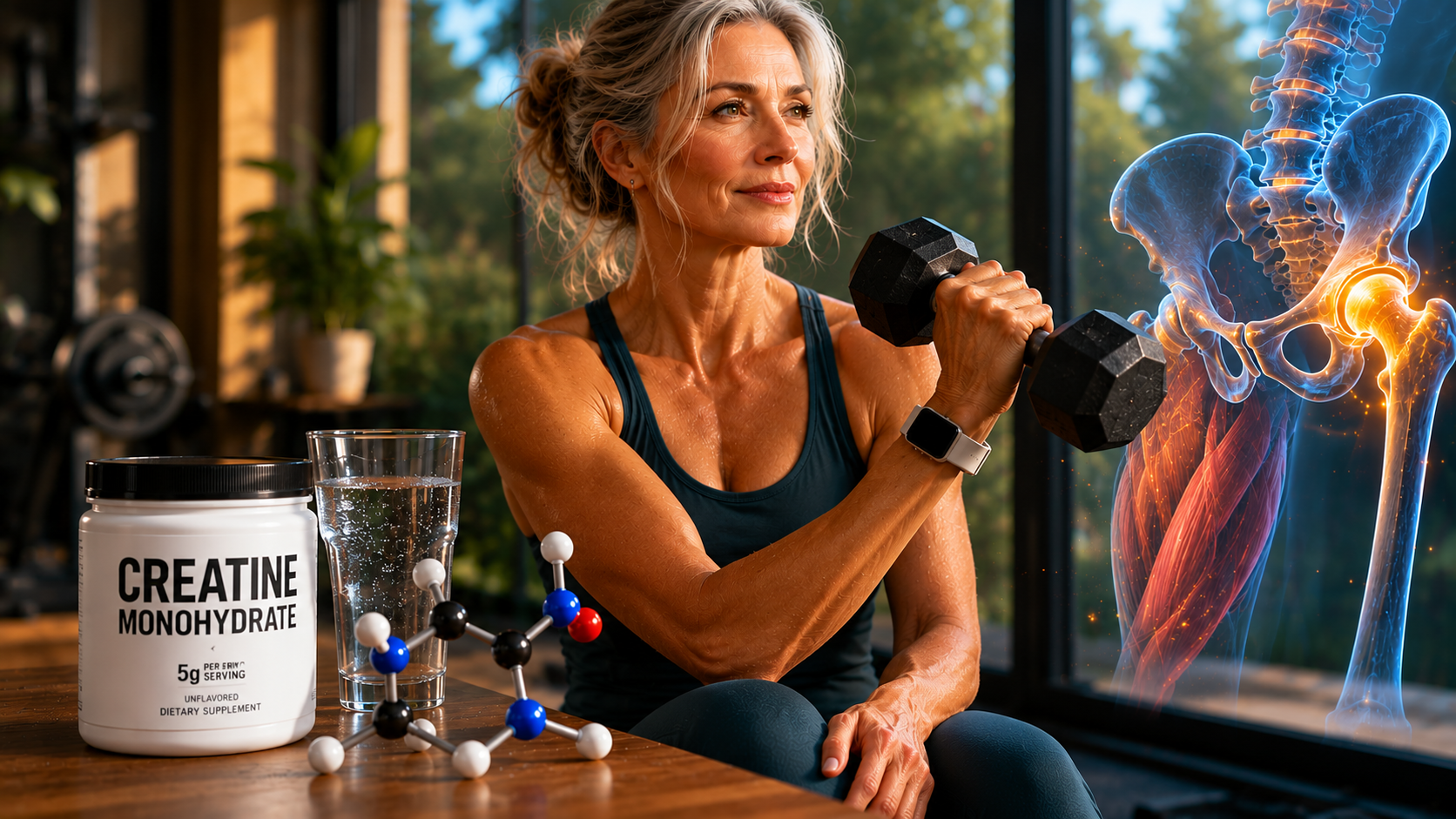
Creatine and menopause: +0.37 kg of muscle and why it's more than it appears.
Creatine and menopause – a combination for which there was no comprehensive review until 2026. This month, the Journal of the International Society of Sports Nutrition published the first meta-analysis of this pair. It summarised seven studies involving 608 women over the age of 40. The result is modest in grams, but significant in context. And with one important clarification that is being loudly amplified in headlines.
What did the meta-analysis show about creatine and menopause
The Naddafha, Antonio, and Kreider team gathered placebo-controlled studies from 2000 to 2025. Criteria: women over 40, duration of at least six weeks. Measurements: DXA for muscle mass, 1RM for strength, BMD for bone density. The summary included 7 RCTs, 608 participants. Study durations ranged from 12 to 104 weeks.
The main result can be summarised by two conditions: dose 5g of creatine per day and above. Plus Strength training. If both conditions are met – a small, but statistically significant increase in muscle mass and leg press strength. Without strength training – zero effect. A dose of 3g or less – also zero. This is the working definition of creatine menopause in a practical format: dose × training, not dose alone.
In figures: approximately +0.37kg of lean body mass compared to placebo over a year. This is not «a pathetic 370 grams». For a body over 60, which loses muscle every year without additional effort, this is a successful body recomposition for the year. On a 5-year horizon, that's two kilograms of retained muscle. On a 10-year horizon, that's a different aging scenario.
Why do muscles melt away faster after menopause
Oestrogen isn't just about reproduction. It supports protein synthesis in muscle, regulates insulin sensitivity, and curbs inflammation in muscle tissue. When its decline becomes prolonged, muscles react with what's known as anabolic resistance. This means they need more protein and more exertion to give the same response they did ten years ago.
The bone is melting in parallel. Women after the menopause lose up to 1% of bone mass per year. This process is particularly rapid in the first 5-7 years after the last menstruation. Muscle weakness plus brittle bones mean one outcome – a sharply increased risk of fractures. Especially of the hips.
Creatine fits logically into this pattern. It increases the phosphocreatine stores in the muscle. More phosphocreatine means more «explosive» energy per rep. More quality reps mean a greater stimulus for protein synthesis. More protein synthesis means more muscle. In a young body, this link works on its own, while in an older one it requires a boost.
How much do you need: 5 grams and a power boost on top
The dose that worked in the meta-analysis is 5g of creatine monohydrate daily. Not «10-20g loading for a week.» Not «sporadically pre-workout.» Daily, consistently, 5g.
The analysis also noted a dose-response signal: each additional gram over 3 g added to the muscle mass effect. However, the authors frankly noted that this conclusion was based on a small number of participants and was statistically weak. Therefore, a sensible guideline is 5 g. No heroics, no «stockpiling».
Strength training is essential. Creatine alone, without exercise, has not produced any noticeable results in this age group. Current recommendations suggest Strength training after 50 at least twice a week. This is the minimum at which creatine starts to justify itself.
What about bones: why creatine didn't save from osteoporosis
Here's the most interesting part of the meta-analysis. Public headlines often state that creatine «strengthens bones». A check on 608 women shows: there is no overall effect on BMD. The lumbar spine was examined. Full skeleton. Thigh. Nothing.
The exception is the femoral neck. This is the part of the bone where a fracture most often leads to hip replacement surgery and a loss of independence. In a 12-month study by Chilibeck in 2015, creatine combined with strength training slowed the loss of BMD in the femoral neck from -3.91 TP6T to -1.21 TP6T compared with placebo.
This is an honest result, and it carries more weight than the banal «makes bones stronger.» This is the real mechanism of creatine in menopause concerning the skeleton. Creatine does not increase bone density. It slows down loss at the most critical point. If the choice is «to make bones stronger,» this is not the tool. If the choice is «to prevent them from being rapidly destroyed where a fracture costs more than anything else,» it is a working tool.
When creatine doesn’t work during the menopause: two reasons for failure
The first is a dose of less than 3 g. At this dosage, the meta-analysis found no effect whatsoever – neither on muscle mass nor on strength. This is important for those who see «creatine» listed as an ingredient in a multi-ingredient supplement at a dosage of 1.5 g. That doesn’t count.
Secondly, creatine without strength training. Women without resistance training achieved the same as women on placebo. Creatine is a stimulus enhancer, not the stimulus itself. No stimulus, nothing to enhance.
The third failure scenario is irregularity. Creatine builds up in the muscle over 3-4 weeks of daily intake. Taking it «whenever I remember» does not create this baseline. This is not about an «acute» effect before a workout, but about chronic tissue saturation.
The most commonly reported side effect in the studies was a short-term water retention in the first 2-3 weeks (around 0.5-1 kg). No serious side effects were recorded in the 608 participants.
How does this look in practice
The specific creatine protocol for menopause, based on the evidence: 5 g of creatine monohydrate per day, every day. Along with 2–3 strength training sessions a week. No trial month, no «loading phase». The effect on the muscles will appear in 8-12 weeks. The effect on the hip joint will appear in 12 months, no sooner.
The time of day you take it isn’t critical. Studies have tested both the morning and the post-workout window — and found no difference. The best time is the one that’s easiest to remember. Many participants took it with their morning coffee.
There is no need to take it with yoghurt or special water. Monohydrate is the best-studied form. All seven studies included in the meta-analysis used this form. More expensive forms (HCl, magnesium chelate, creatine) showed no benefits in this population.
As for compatibility with caffeine, the long-standing myth that coffee «washes out» creatine has not been substantiated in any of the seven studies included in the meta-analysis. Most participants routinely consumed coffee, tea and creatine simultaneously. The same applies to protein supplements: creatine plus a protein shake after strength training is the most common combination in the protocols studied.
Here’s a «starting from scratch» plan for women aged 50 and over. Week one: establish a routine of taking 5 g of creatine every day at the same time. Weeks two and three: add a strength training programme twice a week, focusing on basic movements for the major muscle groups. After a month: assess how well you’re coping and increase strength training to three times a week. After three months: have a DXA scan to see the initial changes. Don’t do it any sooner — re-measuring too soon can give the illusion of a plateau or a setback.
[Your figure - how long have you been taking creatine and what do you notice in the gym].
One-sentence conclusion
Creatine and menopause is not a rejuvenation magic, but a tool for mitigating losses: +0.37 kg of muscle per year and slowing down hip bone breakdown, but only at a dose of 5 g and with regular strength training.
Sources
- Naddafha S, Antonio J, Kreider RB, et al. Creatine monohydrate supplementation on muscle mass, strength, and bone mineral density in menopausal women: a systematic review and meta-analysis. Journal of the International Society of Sports Nutrition. 2026;23(1). DOI: 10.1080/15502783.2026.2668435
- Chilibeck PD, Candow DG, Landeryou T, Kaviani M, Paus-Jenssen L. Effects of Creatine and Resistance Training on Bone Health in Postmenopausal Women. Medicine and Science in Sports and Exercise. 2015;47(8):1587-1595. DOI: 10.1249/MSS.0000000000000571





 Українська
  English (UK)